A complete guide to Web2 projects to Web3 decentralized development
Web2 to Web3 transformationNot a simple technological replacement, but a fundamental shift from a centralized architecture to a decentralized paradigm. This guide will provide a clear and gradual migration path for teams with mature Web2 products – from wallet authentication, smart contract integration, data decentralized storage to tokenomics design, covering every key technical decision point in the transformation process.
The essential difference between Web2 and Web3
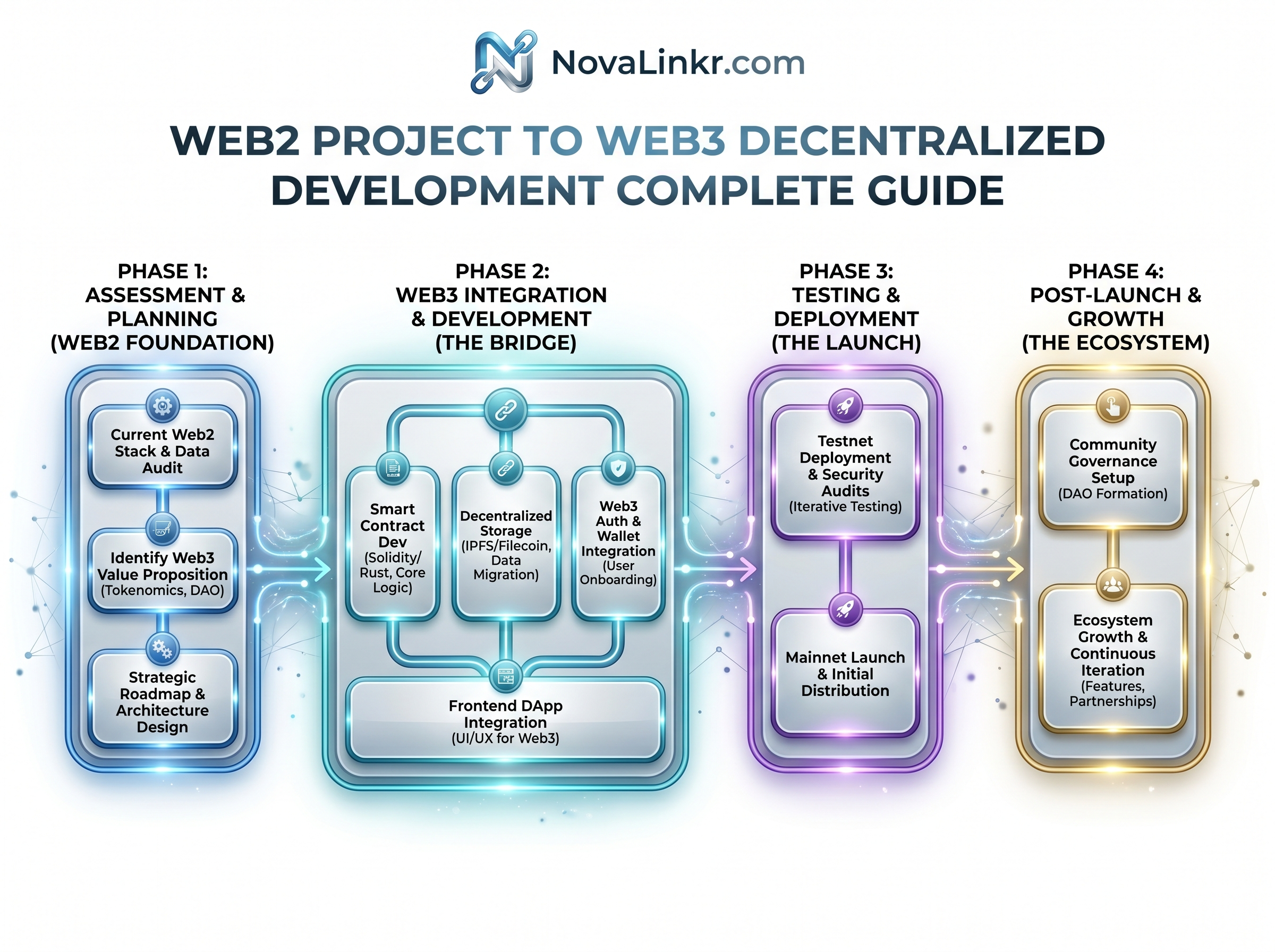
To successfully complete the Web2 to Web3 migration, it is necessary to first deeply understand the fundamental differences between the two in terms of architectural philosophy, data ownership, and trust model.
Core paradigm comparison
| Dimensions | Web2 (Centralized) | Web3 (Decentralized) |
|---|---|---|
| Data ownership | The platform owns user data | Users are in control of their data |
| Identity authentication | Email/mobile phone number + password | Crypto wallet signature verification |
| Backend logic | Centralized server execution | Smart contracts are executed on-chain |
| Data storage | AWS/MySQL/MongoDB | IPFS/Arweave/on-chain storage |
| Payment system | Banking/Alipay/Stripe | Cryptocurrency on-chain transfers |
| Trust model | Trust Platform (Intermediary) | Trust code (permissionless) |
| Governance methods | The board of directors of the company makes decisions | DAO community voting governance |
| Composability | API Integration (Restricted) | Smart contracts are permissionless combinations |
Architectural thinking shifts
🔄 From Request-Response to Event-Driven
Web3 applications synchronize state by listening to on-chain events (Events), replacing the traditional API polling model. The frontend subscribes to contract events through WebSockets to achieve real-time data updates.
🔐 From "Trust Server" to "Verify Everything"
The core principle of Web3 is "Don't Trust, Verify". All key logic is executed by smart contracts, and the results can be independently verified by anyone without trusting a centralized server.
📊 From "platform locking" to "composability"
Web3 protocols are open Lego bricks, and any project can combine existing protocols (such as Uniswap, Aave) without permission to build more complex application layers.
💰 From "advertising monetization" to "token economy"
Web3 projects incentivize user participation, contribution, and governance through tokens, achieving a fair distribution of value among network participants, replacing the traditional advertising-data monetization model.
Why migrate to Web3
Web2 projects choose to transform to Web3 not blindly follow the trend, but are driven by clear business value and technical advantages:
Business drivers
🌍 There is no threshold for globalization
Anyone with a wallet can access the service without permission, without a bank account, without identity verification (KYC optional), covering the world's 2 billion unbanked people.
🤝 User trust and transparency
The business logic is open and transparent, the flow of funds is traceable, and the rules cannot be unilaterally modified, fundamentally solving the platform trust crisis.
🚀 Token Funding and Community Incentives
By issuing governance tokens, NFT loyalty cards, etc., it raises funds and builds a loyal community at a low cost worldwide.
🔗 Ecological synergy
After accessing the DeFi ecosystem, you can easily integrate financial services such as lending, trading, and insurance, without the need to connect to third-party payment channels one by one.
Types of Web2 products suitable for transformation
| Product Type: | Web3 direction | Typical case |
|---|---|---|
| Social platforms | Decentralized identity + content ownership + token incentives | Lens Protocol, Farcaster |
| E-commerce/marketplace | NFT digital goods + on-chain reputation + crypto payments | Shopify NFT, Boson Protocol |
| gaming platform | Chain game assets + Play-to-Earn + NFT props | Axie Infinity, Immutable X |
| Content platform | Creator economy + NFT subscription + decentralized storage | Mirror, Paragraph |
| SaaS tools | Decentralized computing + token payments + open API | Akash Network, Filecoin |
| Financial services | DeFi protocol + on-chain lending + automated market making | Aave, Compound |
Progressive migration strategy
A one-time full rewrite is neither realistic nor necessary. It is recommended to adopt a "progressive decentralization" strategy to migrate core modules on-chain in stages while maintaining user experience continuity.
Four-stage migration route
Phase 1: Wallet integration and dual-track authentication (2-4 weeks)
Added a wallet login option to the existing system and retained the traditional email login. Users can bind their wallet addresses to existing accounts for a smooth transition. This stage is risk-free and can be rolled back at any time.
Phase 2: Core assets on the chain (4-8 weeks)
Tokenize core digital assets (points, membership rights, digital goods) within the platform. Deploy ERC-20/ERC-721 contracts to record asset ownership on-chain and maintain business logic off-chain.
Phase 3: Decentralization of business logic (6-12 weeks)
Migrate core business rules to smart contracts: deal matching, royalty distribution, incentive distribution, etc. Off-chain services are gradually scaled back to indexing and caching roles.
Phase 4: Full Decentralization and DAO Governance (8-16 weeks)
Data storage migrated to IPFS/Arweave, introduced DAO governance mechanism, and transferred platform control to the community. The front-end can be deployed to IPFS to achieve censorship resistance.
Architectural transformation design
The Web2 to Web3 architectural transformation requires redesigning every layer of the system. Here's a typical hybrid architecture solution that balances decentralization with user experience:
Key architectural decisions
- What logic is on the chain?
- Logic involving asset transfer, authority control, and rule arbitration must be on the chain. High-frequency reads, complex calculations, and private data remain off-chain. Judgment criteria: "Does the user need to verify the fairness of this operation?" "
- How to handle on-chain/off-chain data synchronization?
- Adopt the Event Sourcing mode: The on-chain contract triggers the event → the indexing service listens for and synchronizes to the off-chain database→ The frontend reads the off-chain cache through APIs to achieve low-latency queries.
- How to ensure upgradeability?
- Deploy contracts using UUPS or Transparent Proxy mode to allow logical upgrades while maintaining the stored state. Coordinate Timelock + Multi-Signature Governance to approve and upgrade operations.
- How to deal with blockchain performance limitations?
- Adopt Layer2 solution (Arbitrum/Optimism/Base) to reduce gas costs, use Merkle Tree proofs for batch operations, and use off-chain signatures + on-chain settlement for non-critical operations.
Wallet authentication replaces traditional login
Wallet connection is the gateway to Web3 applications, replacing the traditional email/password login system. Secure and decentralized identity verification through SIWE (Sign-In with Ethereum) standard.
Comparison of certification processes
| Steps | Web2 (Traditional Login) | Web3 (Wallet Authentication) |
|---|---|---|
| 1. Initiation | The user enters the email + password | The user clicks on "Connect Wallet" |
| 2. Verification | The server matches the password hash | The server generates a random nonce message |
| 3. Confirmation | If it matches, a JWT will be issued | User wallet signature message |
| 4. Issuance | — | The server verifies the signature recovery address and issues the JWT |
| Security | Passwords can be compromised/phished | The private key does not leave the device and cannot be stolen |
SIWE Certification Implementation (Backend)
// Node.js + Express 实现 SIWE 认证
import { SiweMessage } from 'siwe';
import jwt from 'jsonwebtoken';

// 1. 生成 Nonce(防重放攻击)
app.get('/api/auth/nonce', (req, res) => {
  const nonce = generateNonce(); // 随机32字节
  req.session.nonce = nonce;
  res.json({ nonce });
});

// 2. 验证签名并签发 Token
app.post('/api/auth/verify', async (req, res) => {
  const { message, signature } = req.body;

  try {
    const siweMessage = new SiweMessage(message);
    const result = await siweMessage.verify({ signature });

    // 验证 Nonce 匹配(防重放)
    if (result.data.nonce !== req.session.nonce) {
      return res.status(401).json({ error: 'Invalid nonce' });
    }

    // 验证通过,签发 JWT
    const token = jwt.sign(
      { address: result.data.address, chainId: result.data.chainId },
      process.env.JWT_SECRET,
      { expiresIn: '7d' }
    );

    // 查找或创建用户(与已有Web2账户关联)
    let user = await User.findOne({ walletAddress: result.data.address });
    if (!user) {
      user = await User.create({ walletAddress: result.data.address });
    }

    res.json({ token, user });
  } catch (error) {
    res.status(401).json({ error: 'Signature verification failed' });
  }
});
Front-end wallet connection (wagmi + RainbowKit)
// React 前端钱包连接
import { ConnectButton } from '@rainbow-me/rainbowkit';
import { useAccount, useSignMessage } from 'wagmi';
import { SiweMessage } from 'siwe';

function LoginButton() {
  const { address, isConnected } = useAccount();
  const { signMessageAsync } = useSignMessage();

  const handleLogin = async () => {
    // 1. 获取 Nonce
    const { nonce } = await fetch('/api/auth/nonce').then(r => r.json());

    // 2. 构造 SIWE 消息
    const message = new SiweMessage({
      domain: window.location.host,
      address,
      statement: 'Sign in to NovaLink Platform',
      uri: window.location.origin,
      version: '1',
      chainId: 1,
      nonce,
    });

    // 3. 请求用户签名
    const signature = await signMessageAsync({
      message: message.prepareMessage(),
    });

    // 4. 提交验证
    const { token } = await fetch('/api/auth/verify', {
      method: 'POST',
      headers: { 'Content-Type': 'application/json' },
      body: JSON.stringify({ message: message.prepareMessage(), signature }),
    }).then(r => r.json());

    localStorage.setItem('token', token);
  };

  return isConnected
    ? <button onClick={handleLogin}>Sign In with Wallet</button>
    : <ConnectButton />;
}
Dual-track parallel scheme
Smart contract business layer
Migrating Web2's core business logic to smart contracts is a critical step in decentralization. The contract code is open, transparent, and tamper-proof, providing users with verifiable fairness guarantees.
Business logic migration example: Membership subscription system
// SPDX-License-Identifier: MIT
pragma solidity ^0.8.20;

import "@openzeppelin/contracts/token/ERC721/ERC721.sol";
import "@openzeppelin/contracts/access/Ownable.sol";

/// @title 去中心化会员订阅合约
/// @notice 将传统SaaS订阅模型转化为链上NFT会员卡
contract MembershipNFT is ERC721, Ownable {
    struct Membership {
        uint256 tier;        // 0=Basic, 1=Pro, 2=Enterprise
        uint256 expiry;      // 过期时间戳
        uint256 mintedAt;    // 铸造时间
    }

    mapping(uint256 => Membership) public memberships;
    mapping(uint256 => uint256) public tierPrices; // tier => price in wei
    uint256 private _nextTokenId;

    event MembershipMinted(address indexed user, uint256 tokenId, uint256 tier, uint256 expiry);
    event MembershipRenewed(uint256 tokenId, uint256 newExpiry);

    constructor() ERC721("NovaLink Membership", "NLM") {
        tierPrices[0] = 0.01 ether;   // Basic: ~$30/月
        tierPrices[1] = 0.05 ether;   // Pro: ~50/月
        tierPrices[2] = 0.2 ether;    // Enterprise: ~$600/月
    }

    /// @notice 购买会员(铸造NFT会员卡)
    function subscribe(uint256 tier, uint256 months) external payable {
        require(tier <= 2, "Invalid tier");
        require(months > 0 && months <= 12, "1-12 months");
        require(msg.value >= tierPrices[tier] * months, "Insufficient payment");

        uint256 tokenId = _nextTokenId++;
        uint256 expiry = block.timestamp + (months * 30 days);

        _mint(msg.sender, tokenId);
        memberships[tokenId] = Membership(tier, expiry, block.timestamp);

        emit MembershipMinted(msg.sender, tokenId, tier, expiry);
    }

    /// @notice 续费(延长过期时间)
    function renew(uint256 tokenId, uint256 months) external payable {
        require(ownerOf(tokenId) == msg.sender, "Not owner");
        require(months > 0 && months <= 12, "1-12 months");

        Membership storage m = memberships[tokenId];
        require(msg.value >= tierPrices[m.tier] * months, "Insufficient payment");

        uint256 base = m.expiry > block.timestamp ? m.expiry : block.timestamp;
        m.expiry = base + (months * 30 days);

        emit MembershipRenewed(tokenId, m.expiry);
    }

    /// @notice 检查会员是否有效
    function isActive(uint256 tokenId) public view returns (bool) {
        return memberships[tokenId].expiry > block.timestamp;
    }

    /// @notice 检查地址是否拥有有效会员
    function hasActiveMembership(address user) external view returns (bool) {
        uint256 balance = balanceOf(user);
        for (uint256 i = 0; i < balance; i++) {
            // 简化示例,实际应使用 ERC721Enumerable
            // 遍历用户持有的所有会员NFT
        }
        return false;
    }

    function withdraw() external onlyOwner {
        payable(owner()).transfer(address(this).balance);
    }
}
Web2 vs Web3 business logic comparison
| Business function | Web2 implementation | Web3 implementation |
|---|---|---|
| User payment | Stripe/PayPal API | The contract payable function receives ETH/USDC |
| Membership status | Database field queries | Contract view function validation |
| Subscription expires | Scheduled task checks | On-chain timestamp comparison |
| Refund mechanism | Customer service manual processing | Contracts are automatically refunded on a pro-rata basis |
| Data transparency | The user is not visible | Anyone can verify it on-chain |
| Membership transfer | Usually not supported | NFTs are freely transferred/sold |
Decentralized storage of data
Web3's data storage no longer relies on a single cloud service provider, but is distributed in a decentralized network to achieve censorship resistance, permanent storage, and user data autonomy.
Storage Scheme Selection
| Scheme | Features: | Applicable data types | Cost |
|---|---|---|---|
| IPFS + Filecoin | Content addressing, decentralization, and incentive layers | Static files, media assets, NFT metadata | Medium |
| Arweave | Pay once for permanent storage | Important documents, legal documents, historical data | Disposable |
| Ceramic Network | Variable data flow and user autonomy | User profile, social data, settings | low |
| On-chain storage | Maximum security, never lost | Core state variables, balances, permissions | Extremely high |
| The Graph | On-chain data indexing and querying | Transaction history, event logs, aggregated statistics | By query volume |
IPFS file upload and retrieval
// 使用 Pinata SDK 上传文件到 IPFS
import PinataSDK from '@pinata/sdk';

const pinata = new PinataSDK({
  pinataApiKey: process.env.PINATA_API_KEY,
  pinataSecretApiKey: process.env.PINATA_SECRET_KEY,
});

// 上传用户文件到 IPFS
async function uploadToIPFS(fileBuffer, fileName) {
  const readableStream = Readable.from(fileBuffer);
  readableStream.path = fileName;

  const result = await pinata.pinFileToIPFS(readableStream, {
    pinataMetadata: { name: fileName },
    pinataOptions: { cidVersion: 1 },
  });

  return {
    cid: result.IpfsHash,
    url: `ipfs://${result.IpfsHash}`,
    gateway: `https://gateway.pinata.cloud/ipfs/${result.IpfsHash}`,
  };
}

// 上传 JSON 元数据到 IPFS
async function uploadMetadata(metadata) {
  const result = await pinata.pinJSONToIPFS(metadata, {
    pinataMetadata: { name: `metadata-${Date.now()}` },
  });
  return `ipfs://${result.IpfsHash}`;
}
Ceramic Network user data flow
// 使用 Ceramic + ComposeDB 管理用户可变数据
import { ComposeClient } from '@composedb/client';
import { DID } from 'dids';

// 定义数据模型(GraphQL Schema)
const profileSchema = `
  type UserProfile @createModel(accountRelation: SINGLE, description: "User Profile") {
    displayName: String! @string(maxLength: 100)
    bio: String @string(maxLength: 500)
    avatar: String @string(maxLength: 200)  # IPFS CID
    socialLinks: [String] @list(maxLength: 10)
    updatedAt: DateTime!
  }
`;

// 用户更新自己的 Profile(无需服务器介入)
async function updateProfile(ceramic, profileData) {
  const compose = new ComposeClient({ ceramic, definition });

  await compose.executeQuery(`
    mutation {
      createUserProfile(input: {
        content: {
          displayName: "${profileData.name}"
          bio: "${profileData.bio}"
          avatar: "${profileData.avatarCID}"
          updatedAt: "${new Date().toISOString()}"
        }
      }) {
        document { id }
      }
    }
  `);
}
Data migration strategy
- Thermal data(Frequent reads and writes): Remains in the off-chain database + Redis cache, synchronizing the on-chain state through events
- Cold data(History Archive): Bulk migration to Arweave persistent storage
- User data(Profile/Settings): Migrated to Ceramic, where users control autonomously through DIDs
- Media files(Image/Video): Migrating to IPFS, CID writes to on-chain contracts
Front-end DApp retrofit
The biggest difference between Web3 front-end and traditional web front-end is that it needs to interact with wallets, read and write smart contracts, and listen to on-chain events. Here are the key transformation points for upgrading existing React applications to DApps:
Technology stack upgrades
| Functional modules | Web2 technology | Web3 alternatives |
|---|---|---|
| User authentication | Firebase Auth / Auth0 | wagmi + SIWE |
| Status management | Redux / Zustand | wagmi hooks + React Query |
| API calls | Axios / fetch | ethers.js Contract.call() |
| Real-time updates | WebSocket / SSE | Contract Event Listener |
| File upload | AWS S3 SDK | IPFS / Pinata SDK |
| Payment integration | Stripe Elements | wagmi useSendTransaction |
Contract interaction encapsulation
// 封装合约交互 Hook(React + wagmi v2)
import { useReadContract, useWriteContract, useWaitForTransactionReceipt } from 'wagmi';
import { parseEther } from 'viem';
import { MEMBERSHIP_ABI, MEMBERSHIP_ADDRESS } from '../contracts/membership';

// 读取会员状态
export function useMembershipStatus(tokenId) {
  const { data: isActive } = useReadContract({
    address: MEMBERSHIP_ADDRESS,
    abi: MEMBERSHIP_ABI,
    functionName: 'isActive',
    args: [tokenId],
    watch: true, // 自动轮询更新
  });

  const { data: membership } = useReadContract({
    address: MEMBERSHIP_ADDRESS,
    abi: MEMBERSHIP_ABI,
    functionName: 'memberships',
    args: [tokenId],
  });

  return { isActive, membership };
}

// 购买会员(写入操作)
export function useSubscribe() {
  const { writeContract, data: hash, isPending } = useWriteContract();

  const { isLoading: isConfirming, isSuccess } = useWaitForTransactionReceipt({ hash });

  const subscribe = (tier, months, price) => {
    writeContract({
      address: MEMBERSHIP_ADDRESS,
      abi: MEMBERSHIP_ABI,
      functionName: 'subscribe',
      args: [tier, months],
      value: parseEther(price),
    });
  };

  return { subscribe, isPending, isConfirming, isSuccess, hash };
}
Event listening is synchronized with status
// 监听链上事件实时更新UI
import { useWatchContractEvent } from 'wagmi';
import { useQueryClient } from '@tanstack/react-query';

function MembershipDashboard() {
  const queryClient = useQueryClient();

  // 监听新会员铸造事件
  useWatchContractEvent({
    address: MEMBERSHIP_ADDRESS,
    abi: MEMBERSHIP_ABI,
    eventName: 'MembershipMinted',
    onLogs(logs) {
      logs.forEach(log => {
        const { user, tokenId, tier, expiry } = log.args;
        // 更新本地缓存
        queryClient.invalidateQueries(['membership', tokenId]);
        // 显示通知
        toast.success(`会员 #${tokenId} 已激活!`);
      });
    },
  });

  // 监听续费事件
  useWatchContractEvent({
    address: MEMBERSHIP_ADDRESS,
    abi: MEMBERSHIP_ABI,
    eventName: 'MembershipRenewed',
    onLogs(logs) {
      logs.forEach(log => {
        queryClient.invalidateQueries(['membership', log.args.tokenId]);
      });
    },
  });

  return (<div>{/* Dashboard UI */}</div>);
}
Tokenomics integration
The token economy is the core growth engine of Web3 projects, upgrading the points/membership system of traditional platforms to a token system with real value circulation.
Token economic model design
🪙 Utility Token
Unlock functions in the platform, pay for services, and pay for gas. For example, platform fee discounts, advanced feature usage rights, and API call quotas.
🏛️ Governance Token
Give holders the power to participate in platform decisions: protocol upgrade voting, rate adjustments, new feature proposals. The amount of coins held determines the voting weight.
🎁 Reward Token
Reward users for their contributions: content creation, referral invitations, liquidity provision. Instead of traditional points, they can be freely traded on DEXs.
🖼️ NFT certificates
Represents membership, achievement badges, and limited benefits. Indivisible and unique certificates that can be traded on the secondary market.
Token distribution and release contract
// SPDX-License-Identifier: MIT
pragma solidity ^0.8.20;

import "@openzeppelin/contracts/token/ERC20/ERC20.sol";
import "@openzeppelin/contracts/access/Ownable.sol";

/// @title 平台治理代币 + 线性释放
contract PlatformToken is ERC20, Ownable {
    uint256 public constant MAX_SUPPLY = 1_000_000_000 * 1e18; // 10亿总量

    // 代币分配
    uint256 public constant COMMUNITY_ALLOCATION = 400_000_000 * 1e18; // 40% 社区
    uint256 public constant TEAM_ALLOCATION = 200_000_000 * 1e18;      // 20% 团队
    uint256 public constant INVESTORS_ALLOCATION = 150_000_000 * 1e18;  // 15% 投资者
    uint256 public constant ECOSYSTEM_ALLOCATION = 250_000_000 * 1e18;  // 25% 生态

    // 线性释放
    struct VestingSchedule {
        uint256 total;
        uint256 released;
        uint256 startTime;
        uint256 duration;
        uint256 cliff;  // 锁定期
    }

    mapping(address => VestingSchedule) public vestingSchedules;

    constructor() ERC20("NovaLink Token", "NLT") {
        // 社区份额直接铸造到DAO金库
        _mint(msg.sender, COMMUNITY_ALLOCATION);
    }

    /// @notice 创建线性释放计划
    function createVesting(
        address beneficiary,
        uint256 amount,
        uint256 cliff,
        uint256 duration
    ) external onlyOwner {
        require(vestingSchedules[beneficiary].total == 0, "Already exists");
        vestingSchedules[beneficiary] = VestingSchedule({
            total: amount,
            released: 0,
            startTime: block.timestamp,
            duration: duration,
            cliff: cliff
        });
        _mint(address(this), amount); // 锁定到合约
    }

    /// @notice 领取已释放的代币
    function claimVested() external {
        VestingSchedule storage schedule = vestingSchedules[msg.sender];
        require(schedule.total > 0, "No vesting");
        require(block.timestamp >= schedule.startTime + schedule.cliff, "Cliff");

        uint256 vested = _vestedAmount(schedule);
        uint256 claimable = vested - schedule.released;
        require(claimable > 0, "Nothing to claim");

        schedule.released += claimable;
        _transfer(address(this), msg.sender, claimable);
    }

    function _vestedAmount(VestingSchedule memory s) internal view returns (uint256) {
        if (block.timestamp >= s.startTime + s.duration) return s.total;
        return (s.total * (block.timestamp - s.startTime)) / s.duration;
    }
}
Web2 Credits → Web3 token migration solution
- Snapshot migration: Take a snapshot of the existing points database and generate a Merkle Tree, where users can claim equivalent tokens with proof
- Progressive exchange: Set the redemption window period, and users will actively exchange points 1:1 for on-chain tokens
- Dual-track operation: During the transition period, points and tokens will be parallel, and off-chain points will be automatically synchronized as on-chain balances
- Incentivize migration: Early migrating users receive additional incentives (such as a 10% bonus) to encourage the transition to be completed as soon as possible
DAO governance module
DAOs (Decentralized Autonomous Organizations) hand over the decision-making power of the platform from centralized teams to the community of token holders, enabling true decentralized governance.
Governance process
Proposal creation
Users holding a certain amount of tokens (e.g., 0.1% of the total supply) can submit governance proposals, including protocol upgrades, fee adjustments, fund allocations, etc.
Discussion period (3-7 days)
The community discusses the pros and cons of proposals on forums and Discord, and proposers can modify the content based on feedback.
On-chain voting (5-7 days)
Token holders vote through on-chain contracts, one coin, one vote, or quadratic votes. If the quorum is reached, the proposal will be passed.
Timelock execution (2 days delay)
Proposals that pass enter a timelock, giving the community a final exit window. Automate on-chain operations after expiration.
Governance contract core logic
// 基于 OpenZeppelin Governor 的治理合约
import "@openzeppelin/contracts/governance/Governor.sol";
import "@openzeppelin/contracts/governance/extensions/GovernorSettings.sol";
import "@openzeppelin/contracts/governance/extensions/GovernorCountingSimple.sol";
import "@openzeppelin/contracts/governance/extensions/GovernorVotes.sol";
import "@openzeppelin/contracts/governance/extensions/GovernorTimelockControl.sol";

contract PlatformGovernor is
    Governor,
    GovernorSettings,
    GovernorCountingSimple,
    GovernorVotes,
    GovernorTimelockControl
{
    constructor(
        IVotes token,
        TimelockController timelock
    )
        Governor("NovaLink Governor")
        GovernorSettings(
            7200,     // 投票延迟:1天(按区块数)
            50400,    // 投票持续:7天
            100000e18 // 最低提案门槛:10万代币
        )
        GovernorVotes(token)
        GovernorTimelockControl(timelock)
    {}

    // 法定人数:总供应量的 4%
    function quorum(uint256) public pure override returns (uint256) {
        return 40_000_000e18;
    }
}
Test and deploy
The testing and deployment process of Web3 projects is significantly different from traditional web applications. Once deployed, smart contracts are not modifiable (unless using proxy mode), so they must be adequately tested.
Test pyramid
| Test type | Tools | Coverage content | Target coverage |
|---|---|---|---|
| Unit Testing | Hardhat + Chai | boundary conditions for each contract function | 100% |
| Integration testing | Hardhat Fork | Interaction between contracts, real on-chain state | 90%+ |
| Fuzzing | Foundry Fuzz | Unknown vulnerabilities are found in random inputs | Continuous operation |
| Formal verification | Certora / Halmos | Mathematical proof of contract correctness | Critical path |
| Testnet validation | Sepolia / Mumbai | Real network environment end-to-end | Complete process |
Hardhat deploys scripts
// scripts/deploy.js - 完整部署流程
const { ethers, upgrades } = require("hardhat");

async function main() {
  const [deployer] = await ethers.getSigners();
  console.log("Deploying with:", deployer.address);

  // 1. 部署代币合约
  const Token = await ethers.getContractFactory("PlatformToken");
  const token = await Token.deploy();
  await token.waitForDeployment();
  console.log("Token deployed:", await token.getAddress());

  // 2. 部署 Timelock(2天延迟)
  const Timelock = await ethers.getContractFactory("TimelockController");
  const timelock = await Timelock.deploy(
    172800, // 2 days
    [], // proposers (Governor合约地址后补)
    ["0x0000000000000000000000000000000000000000"], // executors: anyone
    deployer.address
  );
  await timelock.waitForDeployment();

  // 3. 部署治理合约
  const Governor = await ethers.getContractFactory("PlatformGovernor");
  const governor = await Governor.deploy(
    await token.getAddress(),
    await timelock.getAddress()
  );
  await governor.waitForDeployment();

  // 4. 部署会员合约(可升级代理)
  const Membership = await ethers.getContractFactory("MembershipNFT");
  const membership = await upgrades.deployProxy(Membership, [], {
    initializer: 'initialize',
    kind: 'uups',
  });
  await membership.waitForDeployment();

  // 5. 配置权限
  const PROPOSER_ROLE = await timelock.PROPOSER_ROLE();
  await timelock.grantRole(PROPOSER_ROLE, await governor.getAddress());

  console.log("Deployment complete!");
  console.log({ token, timelock, governor, membership });
}

main().catch(console.error);
CI/CD integration
- PR submission: Automatically run Hardhat tests + Slither static analysis + gas reports
- Merge to main: Automatically deploy to the testnet (Sepolia) + front-end preview environment
- Release Tag: Deploy the mainnet after manual approval, and write the contract address to the front-end environment variable
- After deployment: Automatically verify the contract source code to Etherscan + update the subgraph configuration
Security audit and compliance

Web3 projects directly manage user funds, and security breaches can lead to irreversible asset losses. A comprehensive security audit is a necessary step before going live.
Common security risks
🔁 Reentrancy attack
The attacker re-enters the contract in an external call, repeatedly withdrawing funds. Protection: Use ReentrancyGuard or CEI mode.
⚡ Flash loan attack
Utilize unsecured loans to manipulate prices within a single transaction. Protection: Use TWAP oracle, multi-block verification.
🔑 Privilege management vulnerability
Admin key compromise or excessive concentration of privileges. Protection: Multi-signature wallet + Timelock + least privilege principle.
📝 Signature replay
Valid signatures are reused to perform multiple operations. Protection: Bind nonce + chainId + expiration time.
Audit process
- Internal Code Review: Cross-review by teams to ensure logical correctness
- Automated scanning: Slither + Mythril discovers known vulnerability patterns
- Fuzz testing: Foundry Fuzz runs continuously > 1 million random inputs
- Third-party audit: CertiK / Trail of Bits / OpenZeppelin professional audit
- Bug Bounty: Launched a bug bounty program after launch, and continued to be tested by the community
- Monitoring and Alerting: Deploy on-chain monitoring (Forta Network) to provide real-time early warning of abnormal operations
Compliance considerations
Practical case analysis
Here are three real-world examples of different types of Web2 products successfully transforming into Web3, showcasing different migration strategies and technology options:
Case 1: Social Platform → Decentralized Social Networking
| Dimensions | Pre-Transformation (Web2) | Post-Transformation (Web3) |
|---|---|---|
| User system | Mobile Number Registration + OAuth | Wallet Login + Lens Profile NFT |
| Content storage | MongoDB + CDN | Arweave Persistent Storage + IPFS Cache |
| Focus on relationships | Database Join query | On-chain Follow NFT |
| Content monetization | Advertising Division | NFT minting + token tipping + paid subscription |
| Content moderation | Unified review of the platform | Community governance voting + reputation system |
| Migration cycle | 6 months (progressive) | |
Case 2: E-commerce platform → decentralized marketplace
| Dimensions | Pre-Transformation (Web2) | Post-Transformation (Web3) |
|---|---|---|
| Payment system | Stripe + PayPal | USDC/ETH on-chain payment + smart contract escrow |
| Reputation system | In-platform scoring | On-chain SBT reputation certificate (non-transferable) |
| Dispute arbitration | Customer service manual processing | Kleros Decentralized Arbitration Tribunal |
| Loyalty program | Points Mall | ERC-20 Loyalty Token (Tradable) |
| Supply chain traceability | Internal ERP records | On-chain full-link traceability |
| Migration cycle | 9 months (core module installment chaining) | |
Case 3: SaaS platform → decentralized protocol
| Dimensions | Pre-Transformation (Web2) | Post-Transformation (Web3) |
|---|---|---|
| Subscription pays | Monthly/yearly credit cards | Token staking to obtain service credits |
| API access | API Key + Rate Limit | Token payment per-call + permissionless access |
| Product decisions | The product manager made a decision | DAO governance votes determine the roadmap |
| Income distribution | The company's profits are retained | Protocol revenue is distributed in proportion to token holdings |
| Openness | Closed ecology | Open source license + permissionless fork |
| Migration cycle | 12 months (including DAO governance transition) | |
Development process and cycle
Based on the practical experience of the NovaLinkR team in multiple Web2-to-Web3 projects, the typical migration development process is as follows:
Status Assessment and Architecture Planning (2-3 weeks)
Audit the existing system architecture, identify chainable modules, and develop a phased migration plan. Output: Technical assessment report, migration architecture diagram, milestone plan.
Smart contract development and audit (4-8 weeks)
Write business contracts, token contracts, and governance contracts. Complete unit testing (100% coverage), fuzz testing, and third-party security audits.
Back-end service retrofit (3-6 weeks)
Build on-chain event indexing services, integrate IPFS storage, realize off-chain signature verification, and transform user authentication systems.
Front-end DApp upgrade (3-5 weeks)
Integrate wallet connection, implement contract interaction UI, listen to on-chain events, and IPFS file upload components. Maintain UX consistency.
Testnet validation and stress testing (2-3 weeks)
System-wide joint commissioning test, gas optimization, boundary condition verification, performance stress test. Early user beta testing.
Mainnet Deployment and Data Migration (1-2 weeks)
Contract deployment mainnet, stock data migration, user account mapping, and monitoring alarm configuration. Gradually open the user migration portal.
Project budget reference
| Project scale | Migration scope | Cycle | Budget Range |
|---|---|---|---|
| Lightweight | Wallet login + single contract + token issuance | 6-8 weeks | $30,000 - $60,000 |
| Medium size | Core business on-chain + DApp front-end + event index | 12-16 weeks | $80,000 - 50,000 |
| Large projects | Fully decentralized + DAO governance + multi-chain deployment | 20-30 weeks | 00,000 - $500,000 |
The NovaLinkR team has extensive experience in delivering decentralized systems, providing one-stop transformation solutions from architecture evaluation to contract development, front-end DApps to DAO governance.Contact us todayGet free technical advice and migration assessments.