A complete guide to NFT platform development
NFT (Non-Fungible Token)It is a digital asset certificate based on blockchain technology, and each token is unique and irreplaceable. NFT platforms provide creators and collectors with a complete infrastructure to mint, display, and trade digital assets. This article will comprehensively analyze the underlying principles, platform architecture design, and engineering practices of NFT from a technical perspective.
What is NFT?
NFT full name Non-Fungible Token, is a cryptographic digital asset on a blockchain network. Unlike fungible tokens like Bitcoin and Ethereum, each NFT has a unique token ID, representing an indivisible and non-interchangeable digital proof of ownership.
The core features of NFTs
🔐 uniqueness
Each NFT has a globally unique Token ID that cannot be forged or replicated on-chain, fundamentally ensuring the scarcity of digital assets.
🔗 It cannot be tampered with
The creation records, transfer history, and ownership information of NFTs are all written to the blockchain, and no one can unilaterally modify or delete them.
📦 Programmability
Define the behavioral logic of NFTs through smart contracts, including complex business rules such as royalty distribution, split mergers, conditional transfers, and automatic destruction.
🌐 Interoperability
Based on open standards such as ERC-721/ERC-1155, NFTs can be freely circulated and displayed across different platforms, wallets, and marketplaces.
The difference between NFTs and traditional digital assets
| Contrast dimensions | NFTs (Non-Fungible Tokens) | FT (Fungible Tokens such as ETH) | Traditional digital files |
|---|---|---|---|
| uniqueness | Each one is unique | Each is exactly equivalent | Unlimited reproduction |
| Severability | Indivisible (whole trade) | Divisible to decimals | Not applicable |
| Proof of ownership | Permanent record on the chain | On-chain balance | There is no credible proof |
| Transfer method | On-chain transaction signatures | On-chain transfers | File copy/authorization |
| Royalty mechanism | Smart contracts are automatically executed | None | Dependence on legal contracts |
NFT development history
Quantum — The first NFT
Kevin McCoy minted the world's first NFT digital artwork "Quantum" on the Namecoin blockchain, pioneering on-chain digital asset confirmation.
CryptoKitties vs ERC-721
The CryptoKitties game exploded, and the ERC-721 standard was officially proposed and widely adopted. For the first time, the Ethereum network was congested with NFT transactions, validating the market demand for NFTs.
ERC-1155 multi-token standard
Enjin proposes the ERC-1155 standard, which supports the management of both fungible and non-fungible tokens in a single contract, significantly reducing gas costs.
The NFT market exploded
Beeple's work sold for $69.3 million, and OpenSea's monthly transaction volume exceeded $3 billion. NFTs have moved from the tech world to the public eye, covering fields such as art, music, gaming, sports, and more.
Technology maturity and deepening of application
Layer2 solutions reduce transaction costs, dynamic NFTs rise, and RWA (Real World Assets) tokenization accelerates. NFT technology has returned from speculative products to practical value, and has been widely implemented in the fields of supply chain, identity authentication, and membership rights.
NFT technical standards
The core technical standards of NFTs define the token's interface specifications, ensuring interoperability between different applications. Here are the mainstream NFT protocol standards:
ERC-721: Non-Fungible Token Standard
ERC-721 is the earliest and most widely used NFT standard, officially adopted by the Ethereum community in 2018. It specifies the core interfaces that NFT contracts must implement:
// SPDX-License-Identifier: MIT
interface IERC721 {
    event Transfer(address indexed from, address indexed to, uint256 indexed tokenId);
    event Approval(address indexed owner, address indexed approved, uint256 indexed tokenId);

    function balanceOf(address owner) external view returns (uint256);
    function ownerOf(uint256 tokenId) external view returns (address);
    function safeTransferFrom(address from, address to, uint256 tokenId) external;
    function approve(address to, uint256 tokenId) external;
    function getApproved(uint256 tokenId) external view returns (address);
    function setApprovalForAll(address operator, bool approved) external;
    function isApprovedForAll(address owner, address operator) external view returns (bool);
}
ERC-1155: Multi-token standard
ERC-1155 supports the management of multiple token types (FT + NFT) in a single contract, suitable for scenarios such as game assets and tickets:
- Batch operations: Transfer multiple tokens in a single transaction, saving 50-90% on gas fees
- Hybrid management: The same contract contains both fungible tokens (such as game coins) and non-fungible tokens (such as equipment)
- Atomized batch casting: Create hundreds of tokens in a single mint operation
- Receive hooks safely: Ensure that the recipient contract handles tokens correctly
ERC-4907: NFTs can be rented
The new standard passed in 2022 adds a separation mechanism between "right to use" and "ownership" for NFTs, supporting time-limited authorization and automatic recycling when expired, suitable for scenarios such as virtual land rental and game prop borrowing.
Cross-chain NFT standard
With the development of the multi-chain ecosystem, cross-chain NFT bridging protocols (such as LayerZero ONFT, Wormhole NFT Bridge) allow NFTs to freely migrate between networks such as Ethereum, Polygon, Solana, BNB Chain, etc.
NFT platform system architecture
A complete NFT platform typically includes the following core modules, which work together to provide users with full-link services from creation to trading:
Core module description
- NFT indexing services
- Listen to on-chain events (Transfer, Mint, Burn) and synchronize data to off-chain databases to provide efficient query and sorting capabilities. It is typically implemented using The Graph subgraph or a self-built Event Listener.
- Deal matching engine
- Handle transaction types such as List, Offer, and Auction, verify signatures, and submit on-chain transactions. Dutch auctions, English auctions and fixed price sales are supported.
- Content moderation system
- Combine AI image recognition with manual review to filter out violating content. Support NSFW detection, copyright fingerprinting, and report handling workflows.
- Royalty distribution contracts
- Following the EIP-2981 standard, each secondary transaction automatically allocates an agreed proportion of the amount to the original creator without the need for centralized platform intervention.
Smart Contract Development
NFT smart contracts are the core of the platform, defining the token's minting rules, transfer logic, and permission control. Here's a typical NFT contract structure based on OpenZeppelin:
// SPDX-License-Identifier: MIT
pragma solidity ^0.8.20;

import "@openzeppelin/contracts/token/ERC721/ERC721.sol";
import "@openzeppelin/contracts/token/ERC721/extensions/ERC721URIStorage.sol";
import "@openzeppelin/contracts/token/ERC721/extensions/ERC721Royalty.sol";
import "@openzeppelin/contracts/access/Ownable.sol";
import "@openzeppelin/contracts/utils/Counters.sol";

contract NovaLinkNFT is ERC721, ERC721URIStorage, ERC721Royalty, Ownable {
    using Counters for Counters.Counter;
    Counters.Counter private _tokenIds;

    uint256 public maxSupply = 10000;
    uint256 public mintPrice = 0.08 ether;
    bool public mintActive = false;

    mapping(address => uint256) public mintCount;
    uint256 public maxPerWallet = 5;

    event NFTMinted(address indexed to, uint256 indexed tokenId, string uri);

    constructor() ERC721("NovaLink Collection", "NOVA") {
        // 默认版税 5%
        _setDefaultRoyalty(msg.sender, 500);
    }

    function mint(string memory tokenURI) public payable {
        require(mintActive, "Minting is not active");
        require(msg.value >= mintPrice, "Insufficient payment");
        require(_tokenIds.current() < maxSupply, "Max supply reached");
        require(mintCount[msg.sender] < maxPerWallet, "Exceeds per-wallet limit");

        _tokenIds.increment();
        uint256 newTokenId = _tokenIds.current();

        _safeMint(msg.sender, newTokenId);
        _setTokenURI(newTokenId, tokenURI);

        mintCount[msg.sender]++;
        emit NFTMinted(msg.sender, newTokenId, tokenURI);
    }

    function batchMint(string[] memory uris) public payable {
        require(uris.length > 0 && uris.length <= 10, "Invalid batch size");
        require(msg.value >= mintPrice * uris.length, "Insufficient payment");

        for (uint i = 0; i < uris.length; i++) {
            _tokenIds.increment();
            uint256 newTokenId = _tokenIds.current();
            _safeMint(msg.sender, newTokenId);
            _setTokenURI(newTokenId, uris[i]);
            emit NFTMinted(msg.sender, newTokenId, uris[i]);
        }
        mintCount[msg.sender] += uris.length;
    }

    function toggleMint() external onlyOwner {
        mintActive = !mintActive;
    }

    function withdraw() external onlyOwner {
        payable(owner()).transfer(address(this).balance);
    }

    // Override required functions
    function _burn(uint256 tokenId) internal override(ERC721, ERC721URIStorage, ERC721Royalty) {
        super._burn(tokenId);
    }

    function tokenURI(uint256 tokenId) public view override(ERC721, ERC721URIStorage) returns (string memory) {
        return super.tokenURI(tokenId);
    }

    function supportsInterface(bytes4 interfaceId) public view override(ERC721, ERC721URIStorage, ERC721Royalty) returns (bool) {
        return super.supportsInterface(interfaceId);
    }
}
Key design considerations
- Gas Optimization: Use ERC721A to achieve O(1) gas consumption for batch minting, saving more than 70% compared to minting on a coin-by-coin basis
- Delayed Reveal: Mint placeholder metadata first, and then reveal the real content uniformly to prevent MEV rush buying
- Whitelist mechanism: Verify whitelist eligibility through Merkle Tree and save on-chain storage costs
- Upgradeable contracts: Adopts UUPS proxy mode to support contract logic upgrades without affecting minted NFTs
- Multi-signature management: Key operations (such as withdrawal, suspension) need to be confirmed by multi-signature wallets to prevent single point risks
Metadata and decentralized storage
The value of NFTs lies not only in the token ID on the chain but also in the metadata associated with them. Metadata describes the NFT's name, description, image, attributes, and other information, and is the basis for display and trading.
Metadata Standard Format (OpenSea Compatible)
{
  "name": "Cosmic Horizon #0042",
  "description": "A digital artwork exploring the intersection of technology and nature.",
  "image": "ipfs://QmX...abc/0042.png",
  "animation_url": "ipfs://QmX...def/0042.mp4",
  "external_url": "https://novalinkr.com/nft/0042",
  "attributes": [
    { "trait_type": "Background", "value": "Deep Space" },
    { "trait_type": "Rarity", "value": "Legendary" },
    { "trait_type": "Generation", "value": 1, "display_type": "number" },
    { "trait_type": "Power Level", "value": 95, "max_value": 100 }
  ]
}
Comparison of storage plans
| Scheme | Features: | Cost | Applicable scenarios |
|---|---|---|---|
| IPFS + Pinata | Content addressing, decentralization, industry standards | Billing is based on the amount of storage | Most NFT projects prefer |
| Arweave | One-time payment is stored forever and immutable | One-time fee | High-value artwork, permanent archive |
| AWS S3 + CDN | High-speed access and easy management | Paid monthly | Transition scenario or secondary caching |
| On-chain storage | Fully decentralized, never lost | Extremely high gas fees | Small volume SVG/pixel art |
Storage best practices
- Use IPFS's CID (Content Identifier) as the tokenURI to ensure that the content cannot be tampered with
- Avoid a single point of failure with redundant storage from multiple PINs
- Large files (video/3D models) are uploaded in pieces + loaded progressively
- Metadata JSON is stored separately from media files and supports independent updates
Casting mechanism design
Minting is the process of writing digital content into the blockchain to generate unique NFTs. Different business scenarios require different casting strategies:
Common casting modes
🎯 Fixed price minting
Users can mint by paying a fixed fee, which is suitable for ordinary project issuance. Set a per wallet limit to prevent hoarding.
🏷️ Dutch auction
The starting high price is gradually reduced, and users participate at an acceptable price range. Effectively discover fair prices in the market and reduce gas wars.
📋 Whitelist presale
Verification of eligibility through Merkle Proof, giving early supporters priority purchase rights and discounted prices.
⛽ Lazy Minting
Creators upload their works but do not immediately put them on the chain, and the buyer only executes the minting when they buy them, and the creator has zero gas costs. Platforms like OpenSea are widely adopted.
Casting process (technical implementation)
- Users upload digital files (images/videos/3D models) to the frontend
- The backend uploads the file to IPFS to obtain the CID
- The backend generates metadata JSON and uploads it to IPFS
- The frontend calls the wallet signature and executes the contract mint function
- The contract verifies conditions such as payment amounts, minting limits, and more
- After on-chain confirmation, the indexing service synchronizes the data to the background database
- Users view newly minted NFTs on their personal collections page
NFT trading marketplace
The trading market is the core business module of the NFT platform, supporting buyers and sellers to complete the atomic exchange of assets and funds on the chain.
Trading patterns
| mode | process | Applicable scenarios |
|---|---|---|
| Fixed price | Seller Pricing → Buyer buys directly | Most of the regular transactions |
| British auction | Start low → bid increments → then fill | Rare Items/Artwork |
| Dutch auction | Starting high → decreasing price → first buyer closes | The new series debuted |
| Offer | Buyer bids → seller chooses to accept | The buyer proactively bids |
| Bundle Deals | Multiple NFTs are packaged and sold | Series collection |
Off-chain signature + on-chain settlement
The modern NFT market adopts an off-chain signature scheme, where users only sign when placing orders and submit on-chain transactions when buyers make purchases, significantly reducing the cost of placing orders:
// 卖方签名挂单结构
struct SellOrder {
    address seller;
    address nftContract;
    uint256 tokenId;
    uint256 price;
    uint256 expiry;
    uint256 nonce;
    bytes signature;  // EIP-712 签名
}

// 买方调用市场合约购买
function buyNow(SellOrder calldata order) external payable {
    require(block.timestamp < order.expiry, "Order expired");
    require(msg.value >= order.price, "Insufficient payment");
    require(verifySignature(order), "Invalid signature");

    // 原子交换:NFT → 买方,ETH → 卖方
    IERC721(order.nftContract).safeTransferFrom(order.seller, msg.sender, order.tokenId);

    // 分配资金:平台手续费 + 版税 + 卖方收入
    uint256 platformFee = order.price * platformFeeBps / 10000;
    uint256 royalty = getRoyaltyAmount(order.nftContract, order.tokenId, order.price);
    payable(order.seller).transfer(order.price - platformFee - royalty);
}
Safety audit and risk control
NFT platforms involve a large number of digital assets, and security is a top priority. Here are the safety points that must be taken care of:
Smart contract security
- Re-entry Attack Protection: Use ReentrancyGuard or Checks-Effects-Interactions mode
- integer overflow:Solidity 0.8+ has built-in overflow checking, and requires SafeMath for lower versions
- Permission control: Add modifiers such as onlyOwner and AccessControl to key functions
- Signature replay: Each signature is bound to a nonce and expires immediately after use
- Front-end signature verification: All on-chain transactions must verify signature validity within the contract
Platform security
- API rate limiting: Prevents malicious swipes and DDoS attacks
- Image fingerprint verification: Detect pirate/plagiarized content and protect the rights and interests of original creators
- Fishing protection: Displays the full transaction content before signing the transaction to prevent malicious approval
- Hot wallet/cold wallet separation: The platform funds are managed by multi-signature cold wallets
NFT application scenarios
🎨 Digital Art & Collectibles
Provide artists with global sales channels and support royalty sharing forever. Covers graphic design, 3D art, generative art, AI art, and more.
🎮 GameFi
In-game props, characters, skins, and land are NFTIZED, and players truly own game assets and can circulate them across games.
🎵 Music & Copyright
Musicians directly distribute works, concert tickets, and limited copyrights to fans through NFTs, eliminating middlemen.
🏠 Metaverse
Virtual land and buildings in the metaverse are traded in the form of NFTs, such as Decentraland and The Sandbox.
🆔 Identity and credentials
Academic certificates, qualifications, and membership are issued in the form of soulbound NFTs (SBTs), which are non-transferable but verifiable.
📦 Tokenization of physical assets (RWA)
Digital twins of real estate, luxury goods, wine and other physical assets to achieve fragmented holding and global circulation.
Recommended technology stack
| Levels | Technical selection | Description |
|---|---|---|
| Front | React / Next.js + ethers.js + wagmi | SSR optimizes SEO, and wagmi simplifies wallet interactions |
| Rear End | Node.js / Go + GraphQL | High concurrency processing, GraphQL flexible querying |
| Smart Contract | Solidity + Hardhat + OpenZeppelin | Industrial-grade contract framework with rich audit tools |
| Blockchain | Ethereum / Polygon / Base | Polygon has low cost and Base ecosystem is growing fast |
| Storage | IPFS + Pinata / Arweave | Decentralized permanent storage |
| index | The Graph / Build your own Event Listener | On-chain data is synchronized in real time |
| database | PostgreSQL + Redis + Elasticsearch | Relational Data + Caching + Full-Text Search |
| deployment | Vercel + AWS / GCP + Docker | Front-end CDN acceleration, back-end containerized deployment |
NFT platform development process
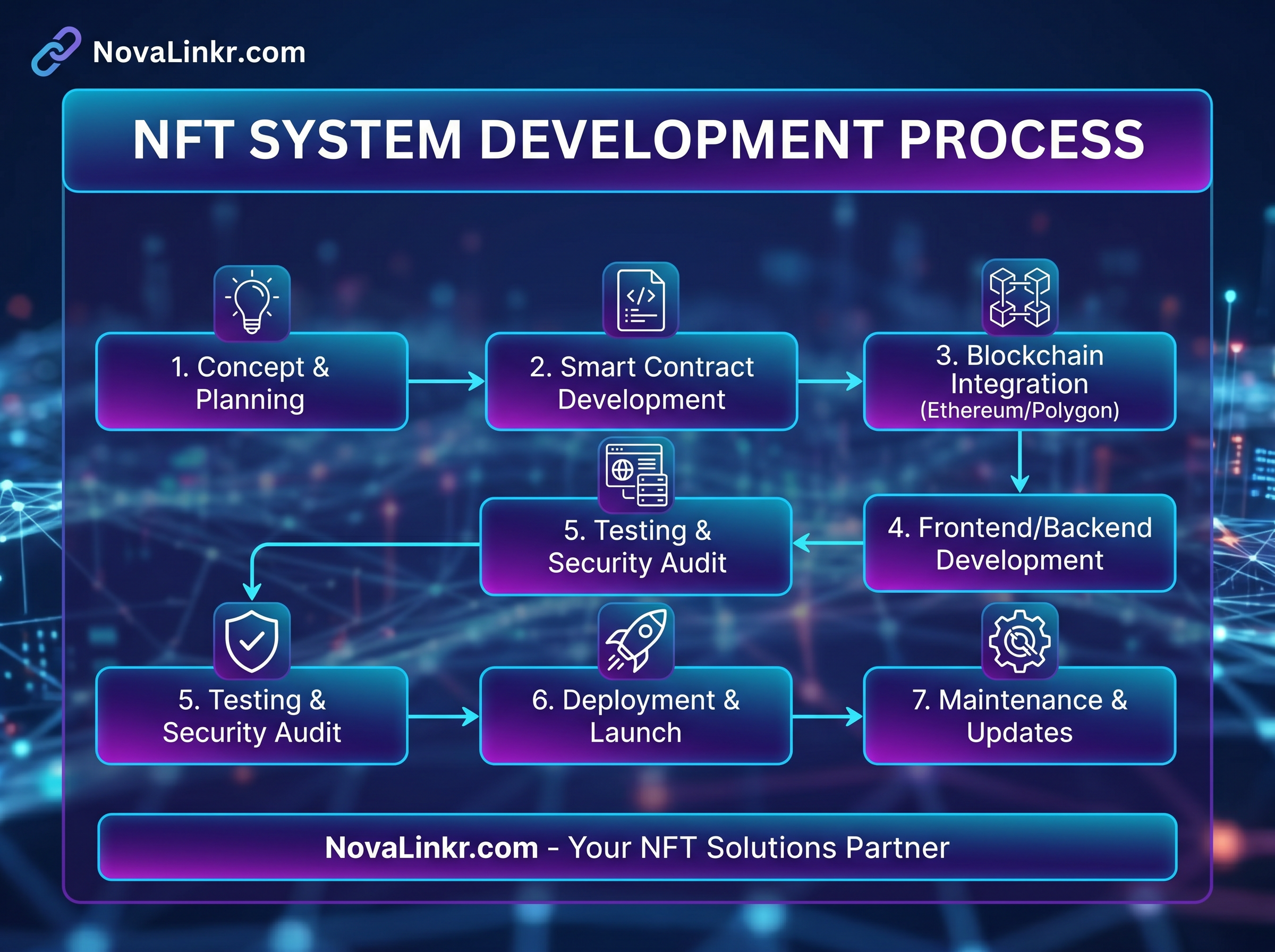
Based on the NovaLinkR team's years of practical experience, the development of a complete NFT platform typically follows the following process:
Requirements Analysis and Architecture Design
Sort out business needs, determine supported chain and token standards, design system architecture, and plan technology selection. Output: PRD, technical solution documentation, prototype drawing.
Smart contract development and testing
Write NFT contracts, market contracts, and auction contracts, complete unit testing (100% coverage) and testnet deployment verification.
Back-end service development
Build core modules such as API services, on-chain event listening, data indexing, file upload, user system, and transaction engine.
Front-end DApp development
Implement wallet connection, NFT display gallery, minting interface, trading market, personal center and other pages and interactions.
Safety audit and stress test
Third-party contract audits, penetration tests, and high-concurrency stress tests ensure system security and stability.
Mainnet deployment and operation
Contract deployment to the mainnet, front-end and back-end launch, monitoring and alarm configuration, operation data dashboard construction, and continuous iterative optimization.
The NovaLinkR team has extensive experience in NFT project delivery, from smart contracts to full-stack front-end and back-end one-stop development.Contact us todayGet a free technical consultation and project quote.