A complete guide to blockchain game GameFi development
GameFi(Game + Finance)It is an emerging field that deeply integrates blockchain financial mechanisms with video games. The assets (characters, equipment, currency) that players acquire in the game exist on-chain in the form of NFTs and tokens, with real economic value and ownership. This article will comprehensively analyze GameFi's architecture design, economic models, smart contract development, and full-stack engineering practices from a technical perspective.
What is GameFi?
GameFi is Game with Finance refers to a blockchain game ecosystem that integrates DeFi mechanisms into gaming experiences. Its core philosophy is:"Play-to-Earn"- Players earn digital assets with real value through game behavior.
The core features of GameFi
🎮 Asset ownership
In-game characters, equipment, land exist as NFTs, and players truly own these assets – freely tradable, used across games, or held permanently.
💰 Play-to-Earn
Players earn token rewards by completing quests, PVP battles, staking assets, and other game behaviors, which can be exchanged for fiat currency.
🏛️ Player governance
Players holding governance tokens can vote on game rules, economic parameters, and content updates, enabling decentralized game governance.
🔄 Interoperability
Game assets based on open standards can be freely circulated between different games, platforms and markets, breaking the closed ecology of traditional games.
GameFi vs traditional gaming
| Dimensions | Traditional games | GameFi chain game |
|---|---|---|
| Asset ownership | The platform owns it, and the account will be lost if it is banned | Held by the player's wallet, it belongs in perpetuity |
| economic system | Closed economy and banned RMT | Open economy and free trading of assets |
| Yield model | Players spend money, and platforms make money | Players participate in the game to earn money |
| Data transparency | Black box (probability opaque) | On-chain verifiable (probability public) |
| Governance methods | The manufacturer decides unilaterally | Community voting governance |
| Interoperability | Data silos | Circulation across game assets |
GameFi history
CryptoKitties — The first year of blockchain gaming
The first blockchain game to explode, each cat is a unique ERC-721 NFT. Demonstrates market demand for on-chain gaming assets, but is limited by Ethereum performance.
DeFi Summer gave birth to the GameFi concept
The liquidity mining boom has inspired the idea of "gamified finance". Andre Cronje first proposed the concept of GameFi – gamifying the yield mechanism of DeFi.
Axie Infinity detonates P2E
Axie Infinity earns more than $350 million per month, and Filipino players make ends meet by playing gold. The P2E model has exploded globally, and the blockchain game track has raised more than $4 billion.
3A blockchain games and infrastructure upgrades
Illuvium, Star Atlas, Big Time and other 3A quality chain games entered the market. Gaming-specific chains like Immutable X and Ronin address performance bottlenecks. Account abstraction lowers the barrier to entry for players.
Full-chain gaming meets AI
Dark Forest, Loot Survivor, and other full-chain games are on the rise. AI NPC, AI-GENERATED CONTENT (AIGC) and blockchain games are combined. The user experience is gradually approaching the level of traditional games.
Game mode classification

| mode | How to play | Income method | Representative project | Technical complexity |
|---|---|---|---|---|
| P2E goldsmithing | PVE/PVP battles to obtain tokens | In-game tokens → exchanged for fiat currency | Axie Infinity | Medium |
| Move-to-Earn | Exercise/Walk to earn tokens | Sports data → token rewards | STEPN, Sweatcoin | Medium |
| Virtual real estate | Buy/build/rent virtual land | Property appreciation + rent | Decentraland, Sandbox | High |
| Cards/Strategies | Collect card battles | Rare card trading | Gods Unchained, Splinterlands | Medium |
| MMORPG | Massively multiplayer online role-playing | Equipment/Character Trading | Big Time, Illuvium | Extremely high |
| Full chain game | The logic runs entirely on-chain | Strategy game + asset appreciation | Dark Forest, Primodium | Extremely high |
| Leisure/social | Light play + social interaction | Mission rewards + social tokens | Pixels, Nifty Island | Medium low |
Technical architecture design
The technical architecture of production-grade GameFi projects needs to balance game performance, on-chain security, and user experience:
On-chain vs. off-chain design decisions
| Data type | Recommended location | Cause |
|---|---|---|
| Asset ownership (NFT/token) | on-chain | Make sure players truly own the assets |
| Trading/market behavior | on-chain | Immutable, transparent and verifiable |
| Key Game Results (PVP Wins & Loses) | On-chain validation | Prevent cheating and ensure fairness |
| Real-time combat logic | Off-chain (server) | High performance requirements and not suitable for on-chain |
| Player position/movement | Off-chain | High-frequency updates, gas costs are too high |
| Social messaging/chatting | Off-chain | High real-time requirements |
| Draw/unboxing results | On-chain random numbers | Probability is transparent to prevent black box operation |
Token Economy Model
Tokenomics is the key to the success or failure of GameFi projects – it determines the long-term sustainability of the gaming ecosystem.
Dual Token Model (Recommended)
🏆 Governance Token
Fixed total for governance voting, advanced staking, and store of value. Usually distributed through IDOs/airdrops. Similar to AXS.
💎 In-Game Token (Utility Token)
No cap or deflationary mechanic for in-game consumption (upgrades, breeding, repairs). Output through game behavior. Similar to SLP.
Token circulation design
// tokenomics/GameToken.sol - 游戏代币合约
// 支持铸造(游戏奖励)和销毁(游戏消耗)

contract GameUtilityToken is ERC20, AccessControl {
    bytes32 public constant MINTER_ROLE = keccak256("MINTER_ROLE");
    bytes32 public constant BURNER_ROLE = keccak256("BURNER_ROLE");

    uint256 public dailyMintCap = 1_000_000 * 1e18;  // 每日铸造上限
    uint256 public todayMinted;
    uint256 public lastMintDay;

    constructor() ERC20("Game Gold", "GOLD") {
        _grantRole(DEFAULT_ADMIN_ROLE, msg.sender);
    }

    /// @notice 游戏服务器调用 - 奖励玩家
    function mintReward(address player, uint256 amount) external onlyRole(MINTER_ROLE) {
        _checkDailyCap(amount);
        _mint(player, amount);
    }

    /// @notice 游戏内消耗 - 升级/繁殖/修理
    function burn(address player, uint256 amount) external onlyRole(BURNER_ROLE) {
        _burn(player, amount);
    }

    function _checkDailyCap(uint256 amount) internal {
        uint256 today = block.timestamp / 1 days;
        if (today != lastMintDay) {
            lastMintDay = today;
            todayMinted = 0;
        }
        todayMinted += amount;
        require(todayMinted <= dailyMintCap, "Daily mint cap exceeded");
    }
}

// 代币消耗场景示例:
// - 角色升级: burn 100 GOLD
// - 装备强化: burn 50 GOLD (失败也消耗)
// - 宠物繁殖: burn 200 GOLD + 2 父母NFT → 1 新NFT
// - 进入副本: burn 10 GOLD (门票)
// - 市场手续费: 5% 交易额 burn
Key points of economic balance
- Faucet < sink: The token output rate must be lower than the consumption rate, otherwise inflation will lead to a death spiral
- Multi-layer consumption design: At least 5 consumption scenarios to disperse the selling pressure
- Dynamic adjustment: Dynamically adjusts output/consumption parameters based on the number of players and token prices
- New player subsidies: Free admission + high rewards in the early stage, lowering the entry barrier
- Lock-up mechanism: Premium rewards require a time lock to prevent immediate sell-offs
NFT game asset system

NFTs are the asset foundation of GameFi – characters, equipment, land, mounts, and other game items are all on-chain in the form of NFTs.
Game NFT metadata design
{
  "name": "Shadow Warrior #1042",
  "description": "A legendary warrior from the Dark Realm",
  "image": "ipfs://Qm.../warrior_1042.png",
  "animation_url": "ipfs://Qm.../warrior_1042_idle.glb",
  "attributes": [
    { "trait_type": "Class", "value": "Warrior" },
    { "trait_type": "Rarity", "value": "Legendary" },
    { "trait_type": "Level", "value": 45, "display_type": "number", "max_value": 100 },
    { "trait_type": "Attack", "value": 892, "display_type": "number" },
    { "trait_type": "Defense", "value": 654, "display_type": "number" },
    { "trait_type": "HP", "value": 12500, "display_type": "number" },
    { "trait_type": "Element", "value": "Dark" },
    { "trait_type": "Generation", "value": 2, "display_type": "number" },
    { "trait_type": "Experience", "value": 85420, "display_type": "number" }
  ],
  "properties": {
    "skills": ["Shadow Strike", "Dark Shield", "Void Step"],
    "equipment_slots": ["weapon", "armor", "helmet", "boots", "ring", "amulet"]
  }
}
Dynamic NFTs (dNFTs)
NFTs in GameFi need to change dynamically (upgrade, evolve, damage) as the game progresses:
// nft/DynamicGameNFT.sol - 动态游戏NFT
contract DynamicGameNFT is ERC721 {
    struct CharacterStats {
        uint16 level;
        uint32 experience;
        uint16 attack;
        uint16 defense;
        uint32 hp;
        uint8 rarity;      // 0-Common, 1-Rare, 2-Epic, 3-Legendary
        uint8 element;     // 0-Fire, 1-Water, 2-Earth, 3-Dark, 4-Light
        uint64 lastBattle; // 上次战斗时间
    }

    mapping(uint256 => CharacterStats) public characters;
    mapping(uint256 => uint256[]) public equippedItems; // tokenId → 装备NFT列表

    event LevelUp(uint256 indexed tokenId, uint16 newLevel);
    event StatsUpdated(uint256 indexed tokenId, uint16 attack, uint16 defense);

    /// @notice 增加经验值(仅游戏服务器)
    function addExperience(uint256 tokenId, uint32 exp) external onlyGameServer {
        CharacterStats storage char = characters[tokenId];
        char.experience += exp;

        // 检查升级
        uint16 newLevel = calculateLevel(char.experience);
        if (newLevel > char.level) {
            char.level = newLevel;
            // 升级加点
            char.attack += 10 * (newLevel - char.level);
            char.defense += 8 * (newLevel - char.level);
            char.hp += 500 * uint32(newLevel - char.level);
            emit LevelUp(tokenId, newLevel);
        }
    }

    /// @notice 装备物品(影响角色属性)
    function equip(uint256 characterId, uint256 itemId) external {
        require(ownerOf(characterId) == msg.sender, "Not owner");
        require(itemNFT.ownerOf(itemId) == msg.sender, "Not item owner");

        equippedItems[characterId].push(itemId);
        // 装备加成
        ItemStats memory item = itemNFT.getStats(itemId);
        characters[characterId].attack += item.attackBonus;
        characters[characterId].defense += item.defenseBonus;
    }

    /// @notice tokenURI 动态生成(反映当前属性)
    function tokenURI(uint256 tokenId) public view override returns (string memory) {
        CharacterStats memory char = characters[tokenId];
        // 动态生成 JSON 元数据
        return generateDynamicMetadata(tokenId, char);
    }
}
Asset scarcity design
| Scarcity | Drop probability | Attribute bonuses | Output Limits |
|---|---|---|---|
| Common | 60% | Base value | Unlimited |
| Rare (Rare) | 25% | +20% | Limited to daily limits |
| Epic | 12% | +50% | Limited weekly |
| Legendary | 3% | +100% | The entire server is limited to 100 |
Smart Contract Development
The GameFi smart contract system includes multiple contract modules that work together:
Core contract architecture
- GameNFT.sol — Game Character/Equipment NFTs (ERC-721/1155)
- GameToken.sol — Game token (ERC-20, supports mint/burn)
- Marketplace.sol — In-game NFT trading marketplace
- Staking.sol — NFT/token staking income
- Breeding.sol — Breeding/synthesis system
- BattleVerifier.sol — On-chain verification of battle results
- LootBox.sol — Unboxing/Drawing Cards (VRF Randoms)
- Governance.sol — Community governance voting
Breeding/synthesis contracts
// breeding/BreedingSystem.sol
contract BreedingSystem is ReentrancyGuard {
    IGameNFT public nft;
    IGameToken public token;
    IRandomOracle public randomOracle;

    uint256 public breedingFee = 200 * 1e18;  // 200 GOLD
    uint256 public cooldownPeriod = 7 days;

    struct BreedingInfo {
        uint256 breedCount;
        uint256 lastBreedTime;
    }
    mapping(uint256 => BreedingInfo) public breedingInfo;

    event Bred(uint256 parent1, uint256 parent2, uint256 childId, uint8 rarity);

    function breed(uint256 parent1Id, uint256 parent2Id) external nonReentrant {
        require(nft.ownerOf(parent1Id) == msg.sender, "Not owner of parent1");
        require(nft.ownerOf(parent2Id) == msg.sender, "Not owner of parent2");
        require(parent1Id != parent2Id, "Cannot self-breed");

        // 冷却检查
        BreedingInfo storage info1 = breedingInfo[parent1Id];
        BreedingInfo storage info2 = breedingInfo[parent2Id];
        require(block.timestamp >= info1.lastBreedTime + cooldownPeriod, "Parent1 on cooldown");
        require(block.timestamp >= info2.lastBreedTime + cooldownPeriod, "Parent2 on cooldown");

        // 消耗代币(繁殖次数越多费用越高)
        uint256 totalFee = breedingFee * (info1.breedCount + info2.breedCount + 2) / 2;
        token.burn(msg.sender, totalFee);

        // 获取随机数决定后代属性
        uint256 randomSeed = randomOracle.getRandomNumber();
        (uint8 rarity, uint16 attack, uint16 defense) = _calculateChildStats(
            parent1Id, parent2Id, randomSeed
        );

        // 铸造后代 NFT
        uint256 childId = nft.mint(msg.sender, rarity, attack, defense);

        // 更新繁殖信息
        info1.breedCount++;
        info1.lastBreedTime = block.timestamp;
        info2.breedCount++;
        info2.lastBreedTime = block.timestamp;

        emit Bred(parent1Id, parent2Id, childId, rarity);
    }

    function _calculateChildStats(uint256 p1, uint256 p2, uint256 seed)
        internal view returns (uint8 rarity, uint16 attack, uint16 defense)
    {
        // 遗传算法:继承父母属性 + 随机变异
        uint16 p1Attack = nft.getAttack(p1);
        uint16 p2Attack = nft.getAttack(p2);
        uint16 baseAttack = (p1Attack + p2Attack) / 2;

        // 10% 概率变异(属性提升 20-50%)
        if (seed % 10 == 0) {
            baseAttack = baseAttack * (120 + seed % 30) / 100;
        }

        attack = baseAttack;
        defense = (nft.getDefense(p1) + nft.getDefense(p2)) / 2;
        rarity = _calculateRarity(seed);
    }
}
Game engine integration with Web3

Integrating traditional game engines with blockchain technology is a core challenge in GameFi development:
Mainstream engine Web3 integration solution
| engine | Integrated solutions | Applicable scenarios | Difficulty |
|---|---|---|---|
| Unity | Thirdweb SDK / Moralis Unity / Web3Unity | Mobile/PC 3D game | Medium |
| Unreal Engine | Thirdweb C++ SDK / Built-in HTTP bridge | 3A quality PC/console game | High |
| Cocos Creator | Web3.js Direct integration | H5/mini-game | low |
| Phaser/PixiJS | ethers.js / viem call | 2D Web Casual Game | low |
| Godot | GDScript HTTP + signature library | Indie game | Medium |
Unity Web3 integration example
// Unity C# - Web3 钱包连接与 NFT 交互
using Thirdweb;

public class Web3GameManager : MonoBehaviour
{
    private ThirdwebSDK sdk;
    private Contract nftContract;

    async void Start()
    {
        sdk = new ThirdwebSDK("polygon");
        nftContract = sdk.GetContract("0x1234...NFT_ADDRESS");
    }

    // 连接钱包
    public async void ConnectWallet()
    {
        string address = await sdk.wallet.Connect(
            new WalletConnection(WalletProvider.MetaMask, chainId: 137)
        );
        Debug.Log($"Connected: {address}");
        LoadPlayerNFTs(address);
    }

    // 加载玩家 NFT 角色
    async void LoadPlayerNFTs(string playerAddress)
    {
        var nfts = await nftContract.ERC721.GetOwned(playerAddress);
        foreach (var nft in nfts)
        {
            // 解析 NFT 属性 → 游戏内角色数据
            var stats = ParseNFTToCharacter(nft.metadata);
            SpawnCharacter(stats);
        }
    }

    // 战斗胜利后铸造奖励
    public async void ClaimBattleReward(int battleId, int rewardAmount)
    {
        var contract = sdk.GetContract("0x5678...REWARD_CONTRACT");
        var result = await contract.Write("claimReward", battleId, rewardAmount);
        Debug.Log($"Reward claimed! TX: {result.receipt.transactionHash}");
    }
}
Account abstraction lowers the threshold
- Sensorless wallet: Players log in with their email/social account to automatically create a smart contract wallet
- Gas payment: The project team pays gas fees for players, and players do not need to hold native tokens
- Session Key: In-game operations do not need to be confirmed, and are automatically signed within a specified time after one authorization
- Bulk trading: Multiple operations are packaged into one transaction (Reward Claim + Upgrade + Equipment completed at once)
On-chain random numbers
Fair random numbers are a cornerstone of GameFi – mechanics like unboxing, dropping, matchmaking, and more rely on unpredictable and verifiable randomness.
Random number scheme comparison
| Scheme | Security | Cost | Delay | Applicable scenarios |
|---|---|---|---|---|
| Chainlink VRF | Very high (verifiable) | $0.1-1/time | Blocks 1-3 | High-value unboxing and card drawing |
| Commit-Reveal | High | 2 Gas | 2 transactions | PVP game selection |
| Block Hash | Medium (can be controlled by miners) | low | Instant | Low-value random events |
| RANDAO | Middle and high | low | Instant | Ethereum PoS |
Chainlink VRF is implemented out of the box
// lootbox/LootBox.sol - VRF 开箱合约
import "@chainlink/contracts/src/v0.8/vrf/VRFConsumerBaseV2.sol";

contract LootBox is VRFConsumerBaseV2 {
    struct BoxRequest {
        address player;
        uint8 boxType;   // 0-Bronze, 1-Silver, 2-Gold
        bool fulfilled;
    }

    mapping(uint256 => BoxRequest) public requests; // requestId → request
    IGameNFT public nft;

    // 开箱(请求随机数)
    function openBox(uint8 boxType) external returns (uint256 requestId) {
        require(boxType <= 2, "Invalid box type");
        // 消耗开箱券或代币...

        requestId = COORDINATOR.requestRandomWords(
            keyHash, subscriptionId, 3, 100000, 1
        );
        requests[requestId] = BoxRequest(msg.sender, boxType, false);
    }

    // Chainlink 回调(发放奖励)
    function fulfillRandomWords(uint256 requestId, uint256[] memory randomWords) internal override {
        BoxRequest storage req = requests[requestId];
        require(!req.fulfilled, "Already fulfilled");
        req.fulfilled = true;

        uint256 random = randomWords[0];
        uint8 rarity = _determineRarity(random, req.boxType);

        // 铸造随机属性的 NFT 奖励
        nft.mintWithRandomStats(req.player, rarity, random);
    }

    function _determineRarity(uint256 random, uint8 boxType) internal pure returns (uint8) {
        uint256 roll = random % 10000;
        if (boxType == 2) { // Gold Box: 更高概率出稀有
            if (roll < 500) return 3;  // 5% Legendary
            if (roll < 2000) return 2; // 15% Epic
            if (roll < 5000) return 1; // 30% Rare
            return 0;                   // 50% Common
        }
        // ... Bronze/Silver 概率表
    }
}
Anti-cheat system
Since gaming behavior in GameFi is directly linked to financial gains, anti-cheat is crucial:
Multi-layered anti-cheat strategy
🔍 Server-side authentication
All key game logic is executed on the server, and the client is only responsible for displaying. The battle results are calculated by the server and signed and submitted on-chain.
🧮 ZK proof
Use zero-knowledge proofs to verify the legitimacy of player actions (e.g., prove that "my character did defeat the boss" without exposing the specific process).
📊 Behavioral analysis
AI models detect abnormal patterns: superhuman speed, impossible operation, 24-hour uninterrupted online and other robot characteristics.
⚖️ Economic constraints
Daily gain cap, energy/stamina system, cooldown. Limit the efficiency of gold mining and reduce the motivation for cheating.
Verification of the results of the battle
// anti-cheat/BattleVerifier.sol
contract BattleVerifier {
    address public gameServer; // 游戏服务器签名地址

    struct BattleResult {
        uint256 battleId;
        address winner;
        address loser;
        uint256 rewardAmount;
        uint256 timestamp;
    }

    mapping(uint256 => bool) public processedBattles;

    /// @notice 验证并发放战斗奖励
    function claimBattleReward(
        BattleResult calldata result,
        bytes calldata serverSignature
    ) external {
        require(msg.sender == result.winner, "Not winner");
        require(!processedBattles[result.battleId], "Already claimed");
        require(block.timestamp - result.timestamp < 1 hours, "Expired");

        // 验证游戏服务器签名
        bytes32 hash = keccak256(abi.encode(result));
        require(recoverSigner(hash, serverSignature) == gameServer, "Invalid signature");

        processedBattles[result.battleId] = true;
        gameToken.mint(result.winner, result.rewardAmount);
    }
}
In-game marketplace
The in-game marketplace, which allows players to freely buy and sell NFT assets, is the core hub of the GameFi economic cycle:
Market function design
- Sold at a fixed price: Seller prices, buyers buy with one click
- Auction mode: English Auction (higher price) and Dutch Auction (decreasing price)
- Sold in bundles: Multiple equipment/character package trades
- Rental system:ERC-4907 NFTs can be rented, and powerful characters are rented out to new players
- Buy in installments: High-value NFTs support installment payments (DeFi lending integration)
- Cross-game trading: A unified NFT marketplace that supports multi-game within the ecosystem
It is proposed to charge a transaction fee of 2.5-5%, with half injected into the treasury (team operation) and half used for token buyback and burning (deflationary mechanism). High fees drive players to use third-party marketplaces.
Recommended technology stack
| module | Technical selection | Description |
|---|---|---|
| game engine | Unity / Unreal Engine / Cocos | Unity/UE for 3D and Cocos for 2D/H5 |
| Blockchain | Polygon / Immutable X / Ronin / Base | Low-gas, high-TPS game-specific chain |
| Smart Contract | Solidity + Foundry + OpenZeppelin | Rapid testing, standardized templates |
| Web3 SDK | Thirdweb / Moralis / Sequence | Simplify wallet integration and NFT operations |
| Random number | Chainlink VRF / Gelato VRF | Verifiable, fair, and random |
| Game server | Go / Rust + Photon / Mirror | High-concurrency real-time multi-person service |
| database | PostgreSQL + Redis + MongoDB | Relational data + cache + game state |
| Asset storage | IPFS + Arweave + CDN | NFT metadata + game assets acceleration |
| Data indexing | The Graph / Goldsky | Real-time querying of on-chain events |
| Monitoring | Dune Analytics + Grafana | Economic data dashboard + O&M monitoring |
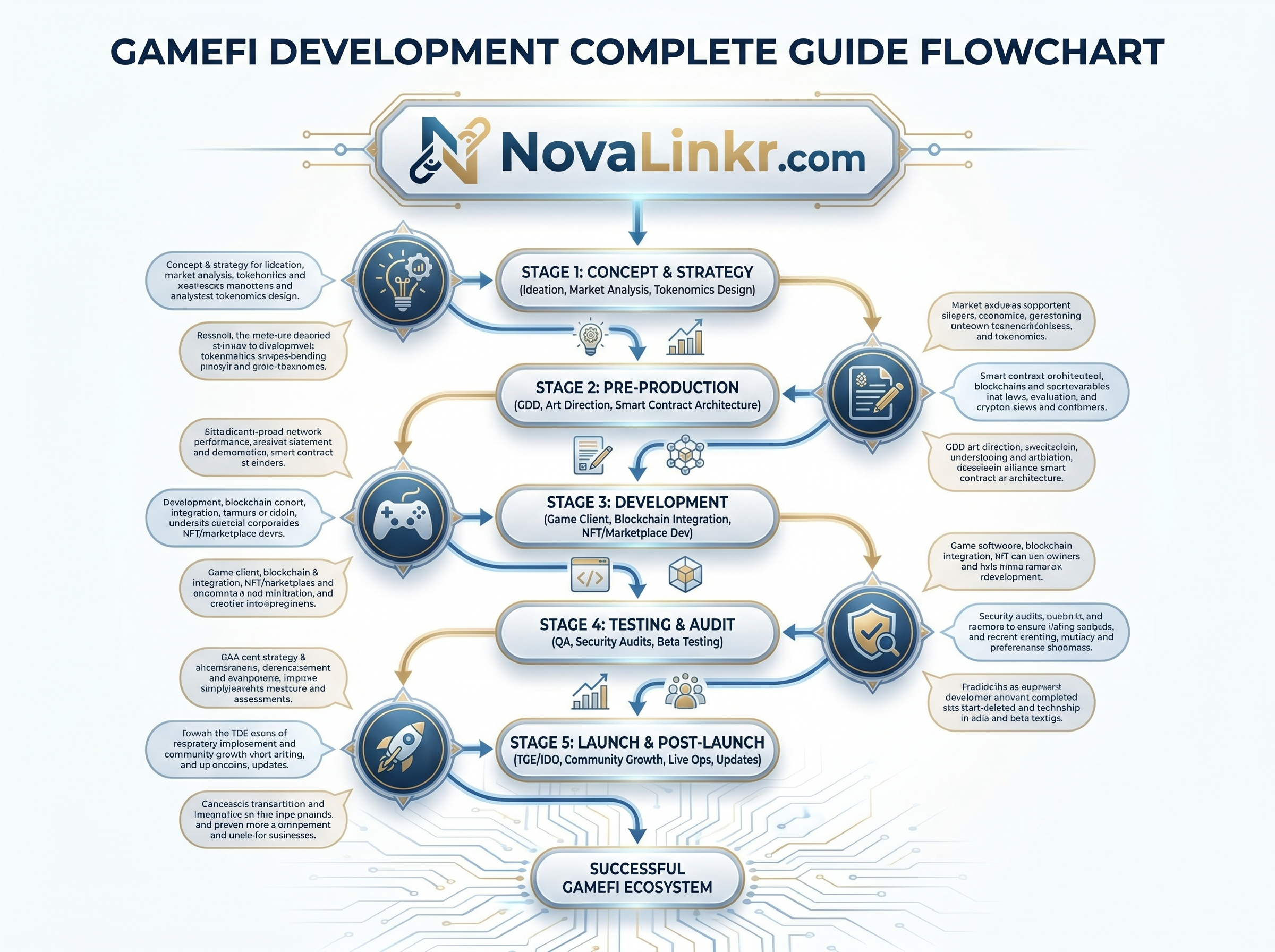
Development process
Based on the NovaLinkR team's experience in delivering blockchain game projects, the following development processes are recommended:
Game Design and Economic Modeling
Gameplay design, token economic model modeling (Excel/Token Engineering), NFT asset system planning, numerical balance design. Output GDD + Economic White Paper.
Smart Contract Development
NFT contract, token contract, market contract, staking contract development. Foundry unit tests are 100% covered, and testnet deployments validate economic models.
Game core development
The game engine develops core gameplay, combat system, and mission system. Web3 SDK integrates wallet connectivity and on-chain interactions.
Backend services and anti-cheating
Game server, matchmaking system, leaderboard, anti-cheat engine, on-chain event indexing service development.
Security audit and testing
Contract security audit, game balance test, economic model stress test, penetration test. Players are invited to participate in the closed beta.
Online operation and iteration
Mainnet deployment, NFT launch/public sale, community operation, season updates, dynamic adjustment of economic parameters, and continuous output of new content.
The NovaLinkR team has extensive experience in delivering GameFi projects, providing one-stop services from economic model design and smart contracts to full-stack game development.Contact us todayGet a free technical consultation and project quote.