A complete guide to cryptocurrency exchange development
Cryptocurrency ExchangeIt is a digital asset trading platform that connects buyers and sellers, providing users with services such as fiat currency exchange, spot trading, and derivatives contracts. As the core infrastructure of the crypto industry, the technical complexity of exchanges far exceeds that of ordinary Internet products - it requires microsecond matching engines, multi-chain wallet systems, real-time risk control engines, and strict compliance systems. This article will comprehensively analyze the underlying architecture, core modules, and engineering practices of exchanges from a technical perspective.
What is a cryptocurrency exchange?
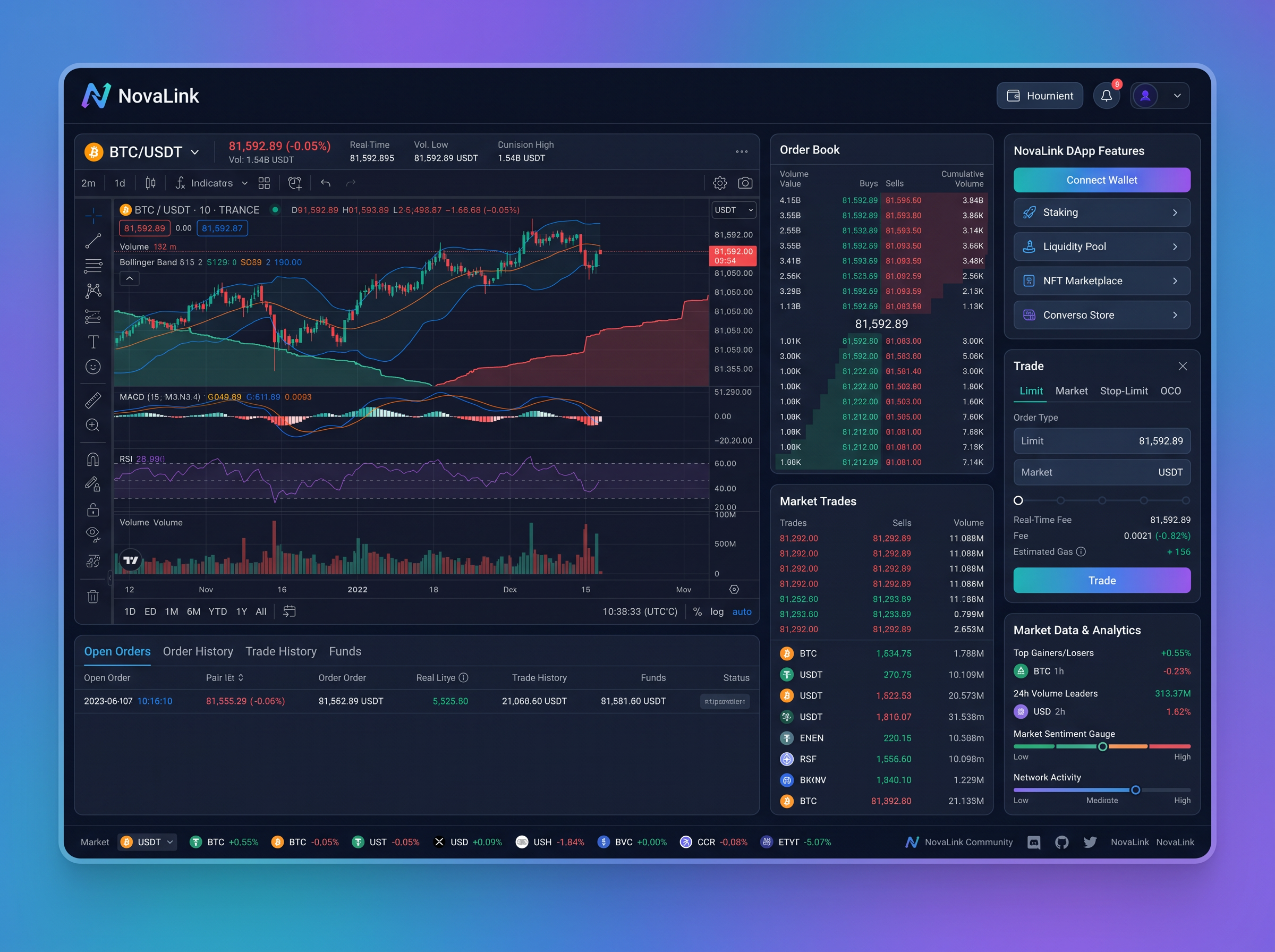
A cryptocurrency exchange is an online platform that allows users to buy, sell, and exchange various digital assets (such as Bitcoin, Ethereum, USDT, etc.). Exchanges play the role of liquidity hubs in the crypto ecosystem and are the main channels for funds to enter and exit the crypto market.
Core functions of the exchange
💱 Price discovery
Through the order book and matching engine to match buyers and sellers in real time, the market supply and demand relationship determines the asset price and forms a fair market pricing.
💧 Liquidity provision
Bringing together a large number of traders and market makers to ensure that users can complete large trades at reasonable prices and with minimal slippage.
🔐 Asset custody
Provide users with secure digital asset storage services, and ensure the safety of funds through hot and cold wallet separation and multi-signature mechanism.
📊 Financial instruments
It provides diversified financial products such as leveraged trading, perpetual contracts, options, and lending to meet the needs of investors with different risk appetites.
Data reference from global leading exchanges
| exchange | Average daily trading volume | Supported currencies | Core features |
|---|---|---|---|
| Binance | 5B+ | 600+ | The world's largest and full-category product line |
| OKX | $5B+ | 350+ | Strong derivatives and Web3 wallets |
| Bybit | $4B+ | 500+ | Leading futures trading experience |
| Coinbase | B+ | 250+ | Compliance benchmarking, listed companies |
| Uniswap (DEX) | B+ | Thousands of species | Decentralized, AMM model |
Exchange classification
| Type | Features: | Advantages: | Disadvantages | representative |
|---|---|---|---|---|
| CEX (Centralized Exchange) | The platform hosts assets and matches the order book | High performance, deep liquidity, good user experience | Trust platform and regulatory risks | Binance, OKX |
| DEX (Decentralized Exchange) | On-chain settlement, user-hosted | No trust, censorship resistance, transparency | Limited performance and dispersed liquidity | Uniswap, dYdX |
| Hybrid exchange | Off-chain matching + on-chain settlement | Balance performance and decentralization | High technical complexity | dYdX v4, Hyperliquid |
CEX vs DEX Technology Comparison
🏢 CEX technical characteristics
Memory matching (microsecond), centralized database, hot and cold wallet separation, KYC enforcement, API rate limit protection. Suitable for high-frequency trading and institutional users.
🌐 DEX technical features
Smart contract execution (seconds), AMM or on-chain order book, user-owned private key, no KYC, gas costs. Suitable for DeFi native users.
System architecture design
The technical architecture of a production-grade cryptocurrency exchange involves dozens of microservices modules, and the following is the hierarchical structure of the core system:
Key performance indicators
- Matching delay:< 100 microseconds (single trading pair), supporting 1 million+ orders per second
- API response:P 99 < 10ms, supporting 100,000+ concurrent connections
- Market push: Full Tick data latency < 5ms, WebSocket broadcast
- System availability: 99.99% (< 52 minutes downtime throughout the year)
- Data consistency: Zero errors in funds, reconciliation frequency ≤ 1 minute
Matching engine
The Matching Engine is the heart of the exchange, responsible for matching buy and sell orders according to the principles of price first and time priority. Its performance directly determines the competitiveness of the exchange.
Matching algorithm core implementation
// matching/engine.go - 撮合引擎核心
type MatchingEngine struct {
    Symbol    string
    OrderBook *OrderBook
    Trades    chan *Trade
    mu        sync.Mutex
}

type OrderBook struct {
    Bids *RedBlackTree  // 买单(价格降序)
    Asks *RedBlackTree  // 卖单(价格升序)
}

type Order struct {
    ID        uint64
    Side      Side      // Buy / Sell
    Type      OrderType // Limit / Market / StopLimit
    Price     Decimal   // 限价
    Quantity  Decimal   // 数量
    Filled    Decimal   // 已成交
    Timestamp int64     // 纳秒时间戳
    UserID    uint64
}

func (e *MatchingEngine) ProcessOrder(order *Order) []*Trade {
    e.mu.Lock()
    defer e.mu.Unlock()

    var trades []*Trade

    if order.Side == Buy {
        // 买单 vs 卖单簿匹配
        trades = e.matchBuyOrder(order)
    } else {
        // 卖单 vs 买单簿匹配
        trades = e.matchSellOrder(order)
    }

    // 未完全成交的限价单挂入订单簿
    if order.Remaining() > 0 && order.Type == Limit {
        e.OrderBook.Insert(order)
    }

    return trades
}

func (e *MatchingEngine) matchBuyOrder(buyOrder *Order) []*Trade {
    var trades []*Trade
    asks := e.OrderBook.Asks

    for asks.Len() > 0 && buyOrder.Remaining() > 0 {
        bestAsk := asks.Min().(*Order)

        // 价格不匹配则停止
        if buyOrder.Type == Limit && buyOrder.Price.LessThan(bestAsk.Price) {
            break
        }

        // 计算成交量
        matchQty := Decimal.Min(buyOrder.Remaining(), bestAsk.Remaining())
        matchPrice := bestAsk.Price // 按挂单价成交

        // 生成成交记录
        trade := &Trade{
            Price:    matchPrice,
            Quantity: matchQty,
            BuyerID:  buyOrder.UserID,
            SellerID: bestAsk.UserID,
            BuyOrderID:  buyOrder.ID,
            SellOrderID: bestAsk.ID,
            Timestamp: time.Now().UnixNano(),
        }
        trades = append(trades, trade)

        // 更新订单状态
        buyOrder.Filled = buyOrder.Filled.Add(matchQty)
        bestAsk.Filled = bestAsk.Filled.Add(matchQty)

        // 完全成交则移除
        if bestAsk.Remaining().IsZero() {
            asks.DeleteMin()
        }
    }
    return trades
}
Matching engine design points
- Memory first: The order book is all maintained in memory, using the red and black tree/skip table to ensure O(log N) insertion and deletion
- Single-threaded matching: Each trading pair is threaded independently, avoiding lock contention and ensuring certainty
- Event traceability: All order operations are written to WAL (Write-Ahead Log) to support fault recovery
- Snapshot mechanism: Persist order book snapshots regularly, combined with WAL for fast restarts
- Serialization: Each order is assigned a globally incremental serial number to ensure consistency in replay
Order type vs. order book
Supported order types
| Order type | Description | Applicable scenarios |
|---|---|---|
| Limit | Pending orders at a specified price will be executed only when the price is reached | Ordinary trading, precise price control |
| Market | Sell now at the best current price | Deal quickly, don't care about the price |
| Stop-Loss | When the trigger price arrives, it will be converted into a market order | Risk management, stop loss protection |
| Stop-Limit | When the trigger price arrives, it becomes a limit order | Precise stop loss |
| IOC (Immediate or Cancel) | The part that can be sold immediately will be canceled | Avoid the risk of pending orders |
| FOK (Fill or Kill) | All closed or all canceled | Large orders are executed accurately |
| Iceberg | Only partial quantities are displayed to reduce market shock | Large transactions hide intent |
| TWAP | Split and execute evenly according to time | Institutional large orders are built in batches |
Order book data structures
// orderbook/book.go - 高性能订单簿
type PriceLevel struct {
    Price    Decimal
    Orders   *list.List  // 同价格FIFO队列
    Quantity Decimal     // 该价位总挂单量
}

type OrderBook struct {
    bids     *skiplist.SkipList  // 买单(降序)
    asks     *skiplist.SkipList  // 卖单(升序)
    orderMap map[uint64]*Order   // O(1) 订单查找
}

// 获取深度数据(L2)
func (ob *OrderBook) GetDepth(levels int) *Depth {
    depth := &Depth{
        Bids: make([]PriceQty, 0, levels),
        Asks: make([]PriceQty, 0, levels),
    }

    iter := ob.bids.Iterator()
    for i := 0; i < levels && iter.Next(); i++ {
        level := iter.Value().(*PriceLevel)
        depth.Bids = append(depth.Bids, PriceQty{
            Price:    level.Price,
            Quantity: level.Quantity,
        })
    }

    iter = ob.asks.Iterator()
    for i := 0; i < levels && iter.Next(); i++ {
        level := iter.Value().(*PriceLevel)
        depth.Asks = append(depth.Asks, PriceQty{
            Price:    level.Price,
            Quantity: level.Quantity,
        })
    }
    return depth
}
Wallet system
The wallet system is responsible for managing the recharge, withdrawal, aggregation, and secure storage of users' digital assets, which is the core of the security of exchange funds.
Wallet architecture
🔥 Hot Wallet
Sign online and handle daily withdrawal requests. Only 5-10% of the expected withdrawal amount on the day will be deposited, and the replenishment process will be automatically triggered.
🧊 Cold Wallet
Offline storage for 90%+ assets. Use HSM hardware signing, multi-signature approval (3/5), physically isolated network.
📥 Top up monitoring
Multi-chain nodes scan blocks in real time, identify the incoming transactions of the user's deposit address, and enter the account after the number of confirmations reaches the standard.
🔄 Aggregation service
Assets scattered across user addresses are regularly aggregated to the main wallet, optimizing UTXO management and gas consumption.
Recharge detection source code
// wallet/deposit_scanner.go - 充值扫描服务
type DepositScanner struct {
    chain       string
    rpcClient   BlockchainClient
    db          *gorm.DB
    confirmations int
}

func (s *DepositScanner) ScanBlock(blockNum uint64) error {
    block, err := s.rpcClient.GetBlockByNumber(blockNum)
    if err != nil { return err }

    for _, tx := range block.Transactions {
        // 检查是否为用户充值地址
        if s.isUserDepositAddress(tx.To) {
            deposit := &Deposit{
                TxHash:      tx.Hash,
                Chain:       s.chain,
                Address:     tx.To,
                Amount:      tx.Value,
                BlockNumber: blockNum,
                Status:      "pending",
            }
            s.db.Create(deposit)
        }

        // ERC-20 Transfer 事件检测
        for _, log := range tx.Logs {
            if s.isERC20Transfer(log) {
                token, to, amount := s.decodeTransfer(log)
                if s.isUserDepositAddress(to) {
                    deposit := &Deposit{
                        TxHash:  tx.Hash,
                        Chain:   s.chain,
                        Token:   token,
                        Address: to,
                        Amount:  amount,
                        Status:  "pending",
                    }
                    s.db.Create(deposit)
                }
            }
        }
    }
    return nil
}

// 确认数达标后入账
func (s *DepositScanner) ConfirmDeposits(currentBlock uint64) {
    var pending []Deposit
    s.db.Where("status = ? AND chain = ?", "pending", s.chain).Find(&pending)

    for _, d := range pending {
        if currentBlock - d.BlockNumber >= uint64(s.confirmations) {
            // 入账到用户余额
            s.creditUserBalance(d.UserID, d.Token, d.Amount)
            d.Status = "confirmed"
            s.db.Save(&d)
        }
    }
}
Futures Trading (Perpetual Contracts)
Perpetual futures are the core derivatives of cryptocurrency exchanges, with no expiration date and anchored to the spot price through a funding rate mechanism.
The core mechanism of perpetual contracts
| mechanism | Description | Implementation points |
|---|---|---|
| Margin | Users stake assets to open positions | Isolated/cross margin mode, initial/maintenance margin rates |
| Leverage | Amplify gains/losses | 1-125x adjustable, dynamic risk limits |
| Mark the price | Fair price against manipulation | Multi-exchange index + EMA smoothing |
| Funding rate | Long-short balance mechanism | Settle every 8 hours, overpay empty or empty more |
| Forced liquidation | liquidation when the margin is insufficient | Stepped liquidation, ADL automatic position reduction |
| Insurance fund | Cover the loss of the position | From the accumulation of surpluses from forced evenization, socialized apportionment is prevented |
Liquidation engine
// liquidation/engine.go - 强平引擎
type LiquidationEngine struct {
    positions  *PositionStore
    markPrices *MarkPriceService
    insurance  *InsuranceFund
}

func (le *LiquidationEngine) CheckPositions() {
    positions := le.positions.GetAllOpen()

    for _, pos := range positions {
        markPrice := le.markPrices.Get(pos.Symbol)
        marginRatio := le.calcMarginRatio(pos, markPrice)

        if marginRatio <= pos.MaintenanceMarginRate {
            le.liquidate(pos, markPrice)
        }
    }
}

func (le *LiquidationEngine) calcMarginRatio(pos *Position, markPrice Decimal) Decimal {
    // 未实现盈亏
    unrealizedPnL := pos.Side.PnL(pos.EntryPrice, markPrice, pos.Size)
    // 账户权益
    equity := pos.Margin.Add(unrealizedPnL)
    // 仓位价值
    positionValue := markPrice.Mul(pos.Size)
    // 保证金率
    return equity.Div(positionValue)
}

func (le *LiquidationEngine) liquidate(pos *Position, markPrice Decimal) {
    // 1. 取消该仓位所有挂单
    le.cancelOpenOrders(pos)
    // 2. 以破产价格提交平仓单
    bankruptcyPrice := le.calcBankruptcyPrice(pos)
    order := &Order{
        Symbol:   pos.Symbol,
        Side:     pos.Side.Opposite(),
        Type:     Market,
        Quantity: pos.Size,
        Source:   "liquidation",
    }
    // 3. 盈余归入保险基金
    proceeds := le.executeClose(order, markPrice)
    if proceeds.GreaterThan(Zero) {
        le.insurance.Add(pos.Symbol, proceeds)
    }
}
Risk control system
Risk control systems act as security barriers for exchanges, monitoring abnormal behavior in real-time and preventing market manipulation and misappropriation of funds.
Risk control level
⚡ Real-time risk control (milliseconds)
Order pre-check: price deviation threshold detection, single amount limit, frequency limit, self-transaction protection. Block abnormal orders before matching.
📊 Near-real-time risk control (second-level)
Account-level monitoring: analysis of short-term profit and loss anomalies, position concentration, IP/device anomalies, and API call patterns.
🔍 Offline risk control (minute)
Global market monitoring: wash transaction detection, price manipulation identification, linked account analysis, abnormal withdrawal mode.
🛡️ Capital risk control
Withdrawal review: large-amount manual review, address whitelist, 24-hour new address cooling, on-chain blacklist database comparison.
Real-time risk control rule engine
// risk/realtime_engine.go
type RiskEngine struct {
    rules    []RiskRule
    metrics  *MetricsCollector
}

type RiskRule interface {
    Check(order *Order, context *RiskContext) *RiskResult
}

// 价格偏离检测
type PriceDeviationRule struct {
    MaxDeviation Decimal  // 如 5%
}

func (r *PriceDeviationRule) Check(order *Order, ctx *RiskContext) *RiskResult {
    if order.Type != Limit { return Pass() }

    lastPrice := ctx.LastTradePrice(order.Symbol)
    deviation := order.Price.Sub(lastPrice).Abs().Div(lastPrice)

    if deviation.GreaterThan(r.MaxDeviation) {
        return Reject("price_deviation_exceeded",
            fmt.Sprintf("偏离 %.2f%% 超过阈值 %.2f%%", deviation*100, r.MaxDeviation*100))
    }
    return Pass()
}

// 频率限制
type RateLimitRule struct {
    MaxOrdersPerSecond int
    window             map[uint64]*slidingWindow
}

func (r *RateLimitRule) Check(order *Order, ctx *RiskContext) *RiskResult {
    w := r.getWindow(order.UserID)
    if w.Count() >= r.MaxOrdersPerSecond {
        return Reject("rate_limit", "下单频率超限")
    }
    w.Add()
    return Pass()
}
Liquidity management
Liquidity is the lifeblood of exchanges. A well-depth order book can provide tighter bid-ask spreads and less slippage, attracting more traders to form a positive cycle.
Sources of liquidity
- Market Maker: Professional institutions continue to place orders on both sides of the buyer and seller to earn spread profits. Fee discounts or rebate incentives are usually given.
- API trader: The quantitative team accessed through the REST/WebSocket/FIX protocol contributes a large number of limit orders.
- Move bricks across the place: Arbitrage robots move liquidity between different exchanges to help price converge.
- Liquidity aggregation: Access to third-party liquidity pools (e.g., B2C2, Cumberland) to replenish depth.
Market maker API design
// 批量下单接口(低延迟专用)
POST /api/v1/mm/batch-orders
{
    "symbol": "BTC-USDT",
    "orders": [
        {"side": "buy",  "price": "67450.00", "qty": "0.5", "type": "limit"},
        {"side": "buy",  "price": "67400.00", "qty": "1.0", "type": "limit"},
        {"side": "sell", "price": "67550.00", "qty": "0.5", "type": "limit"},
        {"side": "sell", "price": "67600.00", "qty": "1.0", "type": "limit"}
    ],
    "cancelPrevious": true  // 原子性替换旧订单
}

// 做市商专属 WebSocket(Colocation 级别)
// 延迟 < 1ms,独立通道,优先处理
ws://exchange.com/ws/mm?apiKey=xxx&dedicatedLine=true
KYC and compliance system
With tighter regulations around the world, KYC (Know Your Customer) and AML (Anti-Money Laundering) have become mandatory requirements for exchanges.
KYC tiered verification
| grade | Verify the content | Permissions |
|---|---|---|
| Level 0 | Email/mobile phone only | Browse the market and cannot be traded |
| Level 1 | ID card + face recognition | Spot trading, daily withdrawal of 2 BTC |
| Level 2 | Proof of address + source of funds | Futures trading, daily withdrawal of 100 BTC |
| Level 3 | Video Audit + Agency Certification | Unlimited, OTC, API high frequency |
AML compliance system
- Transaction Monitoring: Real-time detection of large transactions, split transactions (Structuring), and fast in and out modes
- On-chain analytics: Integrate Chainalysis / Elliptic to identify high-risk addresses (dark web, coin mixers, sanctions lists)
- SAR report: Suspicious activity automatically generates reports and submits them to the financial intelligence unit of each jurisdiction
- Travel rules: Comply with the FATF Travel Rule, large transfers come with sender/receiver identity information
Security system
Multi-layered security protection
🔑 Private key security
HSM hardware encrypted storage, MPC (Multi-Party Computation) shard signing, and threshold signing (TSS) eliminate the risk of single key leakage.
🛡️ Cybersecurity
WAF firewall, DDoS protection (Cloudflare/Akamai), intranet isolation, and zero-trust architecture.
👤 Account security
Enforce 2FA, login device management, operation IP whitelist, anti-phishing code, whitelist lock for withdrawal addresses.
🔒 Data security
Full-link TLS encryption, database field-level encryption, key rotation, and audit logs are tamper-proof.
Recommended technology stack
| module | Technical selection | Description |
|---|---|---|
| Matching engine | Go / C++ / Rust | Low latency, memory safety, and high concurrency |
| Backend services | Go + gRPC + Kafka | Microservices architecture, asynchronous message driven |
| Web front-end | React + TradingView + WebSocket | Professional K-line charts, real-time market information |
| Mobile | Flutter / React Native | Cross-platform, rapid iteration |
| database | PostgreSQL + TimescaleDB + Redis | Transaction data + time series quotes + cache |
| Message queue | Kafka / NATS | High throughput, sequence guaranteed |
| Wallet service | Go + Multi-Chain SDK + HSM | Secure signature, multi-chain adaptation |
| Risk control | Flink / Drools + Redis | Streaming computing, rules engine |
| Monitoring | Prometheus + Grafana + PagerDuty | Full-link tracking, second-level alarm |
| deployment | Kubernetes + Terraform + AWS | Multi-AZ and automatic scaling |
Exchange development process
Based on the delivery experience of the NovaLinkR team in multiple exchange projects, the complete development process is as follows:
Demand planning and compliance assessment
Determine the target market, license requirements, product range (spot/contract/OTC), technology selection and team configuration. Output PRD and compliance scenarios.
Matching engine and core development
Realize matching engine, order management, account system, market service, and build an internal test environment for performance stress testing.
Wallet system development
Multi-chain wallet adaptation, deposit and withdrawal process, hot and cold wallet separation, aggregation strategy, HSM signature integration.
front-end and mobile development
Developing a full-featured interface such as trading interface, candlestick chart, order book depth chart, account management, KYC process, etc.
Risk control and safety audit
Real-time risk control rule deployment, penetration testing, code audit, private key management scheme verification, disaster recovery drills.
Online operation and liquidity construction
Grayscale release, market maker docking, liquidity incentive plan, user growth operation, 7×24 operation and maintenance guarantee.
The NovaLinkR team has successfully delivered multiple cryptocurrency exchange projects, covering the full-stack development of matching engines, multi-chain wallets, and contract systems.Contact us todayGet free technical consultation and customized solutions.