A complete guide to decentralized technology and blockchain
DecentralizationIt is a technical concept that decentralizes control and decision-making from centralized entities to distributed networks.BlockchainIt is one of the core technologies to achieve decentralization, building a value transmission network without trusting intermediaries through cryptography and consensus algorithms. This article will systematically analyze these two revolutionary technologies from the underlying principles to the application practice.
What is decentralization?
Decentralization refers to theThere is no single control centerPower, data, and decision-making are distributed across multiple nodes, and the failure of any single node does not cause the entire system to be paralyzed.
The core concept of decentralization
🌐 Distributed control
The system is maintained by many equal nodes, and no single entity has absolute control. Decisions are made by consensus rather than commands.
🔓 No trust required
There is no need to trust each other or rely on third-party guarantees. Protocol rules are automatically enforced by code and mathematical guarantees.
🛡️ Censorship resistance
There is no centralized authority that can unilaterally review, modify, or delete data. Once the information is written to the network, it is immutable.
💪 High availability
Distributed architecture is naturally fault-tolerant. Even if some nodes go offline, the system can still operate and provide services normally.
Three tiers of decentralization
- Architecture is decentralized: The system consists of multiple physical computers without a single fault node
- Political decentralization: No single organization or individual can control the entire system
- Logical decentralization: Whether the interface and data structure of the system are presented as a whole (blockchain is logically centralized - the whole network shares a state)
Centralization vs Decentralization
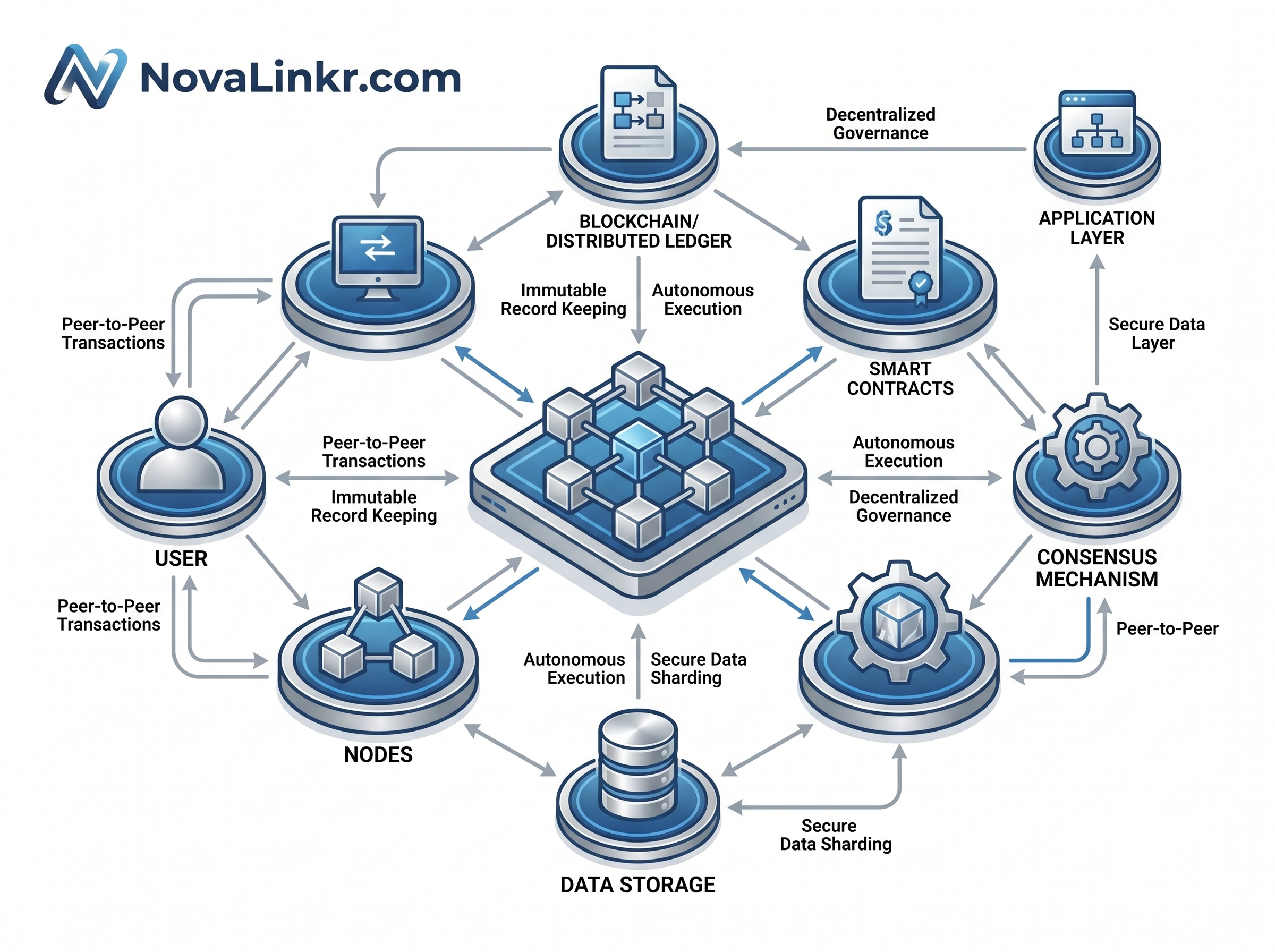
The best way to understand decentralization is to contrast it with traditional centralized systems:
| Contrast dimensions | Centralized system | Decentralized system |
|---|---|---|
| Control mode | Controlled by a single agency | Multi-node co-governance |
| Data storage | Centralized servers | Distributed network-wide redundancy |
| Single point of failure | Present (unavailable if the server is down) | Non-existent (extremely fault-tolerant) |
| Data tampering | Administrators can modify it | 51% consensus is required to change |
| Transparency | Users cannot audit the background | The code is open source and available on the data chain |
| Privacy | The platform holds all user data | Users keep their keys and data independently |
| efficiency | High (fast centralized decision-making) | Lower (consensus required) |
| Trust foundation | Trust the agency brand and the law | Trust code and math |
| Typical examples | Bank, WeChat, Taobao | Bitcoin, Ethereum, IPFS |
Decentralization is not an absolute binary choice. In reality, most systems are on the spectrum between "fully centralized" and "fully decentralized". Project teams need to find the optimal balance between efficiency, security, and decentralization based on business needs.
What is blockchain?
Blockchain is a type of blockchainDistributed ledger technology (DLT)It maintains consistent data state across multiple participants by packaging data into "blocks" in chronological order and cryptographically connecting blockchains into an immutable chain structure.
Definition of the essence of blockchain
In simple terms, blockchain is aDecentralized, immutable, open and transparent distributed database。 Its core innovation is that data consensus can be reached between participants who do not trust each other without the need for third-party arbitration.
The core components of blockchain
📦 Block
The basic storage unit of data. Each block contains transaction data, timestamps, hashes of the previous blocks, and hashes of this block.
🔗 Chain
Blocks are connected end to end by hash pointers to form a chain structure. Modifying any historical block will invalidate the hash value of all subsequent blocks.
🌐 Node Network
Globally distributed computer nodes work together to maintain the same copy of the ledger. The P2P network ensures that data is synchronized between nodes in real-time.
🤝 Consensus
Nodes in the network agree on the validity of new blocks through consensus algorithms (e.g., PoW, PoS).
The data structure of the block
{
  "block_number": 18923451,
  "timestamp": "2025-05-01T12:34:56Z",
  "previous_hash": "0x8a3f...b29c",
  "merkle_root": "0x4d2e...a18f",
  "nonce": 2847561,
  "difficulty": "0x0000000000000000000f...",
  "transactions": [
    {
      "from": "0xAb5...123",
      "to": "0xCd7...456",
      "value": "1.5 ETH",
      "gas_used": 21000,
      "signature": "0x7e9f...3a1b"
    }
  ],
  "block_hash": "0x1c4a...e7d2"
}
How blockchain works
Blockchain networks enable trusted data management in a decentralized environment through a series of sophisticated technical processes:
Transaction lifecycle
Initiate a transaction
Users create transactions (such as transfers, contract calls) through wallets and digitally sign transaction data using private keys, ensuring the authenticity and non-repudiation of transactions.
broadcast to the network
The signed transaction is broadcast to all connected nodes over a P2P network. Each node puts the transaction into the local mempool to be processed.
Validate transactions
Nodes verify the legitimacy of transactions: whether the signature is valid, whether the balance is sufficient, whether the nonce is correct, whether the gas is sufficient, etc. Invalid transactions are rejected.
Pack out the blocks
Block producing nodes (miners/validators) select transactions from the mempool, sort them into new blocks according to rules, and calculate the Merkle Root and block hash.
Consensus confirmation
New blocks are recognized by the entire network through consensus mechanisms (such as PoW calculation, PoS voting). Other nodes verify the validity of the block and append it to the local chain.
Final confirmation
As subsequent blocks continue to accumulate, the number of confirmed transactions increases, and the probability of being reversed approaches zero. Bitcoin is usually considered final with 6 confirmations.
Cryptography Basics
Cryptography is the cornerstone of blockchain security. Blockchain uses a variety of cryptographic techniques to ensure data integrity, identity authentication, and privacy protection.
Hash Function
The hash function converts an arbitrarily length input into a fixed-length output (summary) with unidirectional, anti-collision, and avalanche effects:
// SHA-256 哈希示例
Input:  "Hello, Blockchain!"
Output: "7f83b1657ff1fc53b92dc18148a1d65dfc2d4b1fa3d677284addd200126d9069"

// 即使改变一个字符,哈希值完全不同(雪崩效应)
Input:  "Hello, Blockchain?"
Output: "a1b2c3d4e5f6789...完全不同的256位哈希值"
Asymmetric encryption (public key cryptography)
Each user holds a pair of keys: the public key (address, publicable) and the private key (absolutely confidential).
- Private key signing: Sign the transaction with the private key to prove the identity of the transaction initiator
- Public key verification: Anyone can use the public key to verify that the signature is valid, but the private key cannot be reversed
- Address generation: The public key is hashed to generate a blockchain address (e.g., an Ethereum address starting with 0x)
Merkle tree
A Merkle tree is a hash binary tree structure used to efficiently verify the integrity of large amounts of data:
📊 Data integrity
Simply compare Merkle Root to determine whether the entire dataset has been tampered with, without checking item by item.
⚡ Light node verification
Light nodes only need to download the block header and Merkle path to verify that a transaction exists in a block.
Zero-Knowledge Proofs (ZKPs)
Zero-knowledge proofs allow one party to prove a statement to another party without revealing any additional information. It is widely used in blockchain for private transactions and Layer2 scaling (such as zkRollup).
Consensus mechanism
The consensus mechanism is at the heart of blockchain, and it solvesByzantine General Problem- How to get scattered nodes to agree on the same data state in an untrusted network.
Comparison of mainstream consensus algorithms
| Consensus mechanism | Principle | Pros: | Cons: | Representative project |
|---|---|---|---|---|
| PoW Proof of work |
Nodes compete for block rights through computational problems | High degree of decentralization and strong security | Huge energy consumption and low TPS | Bitcoin |
| PoS Proof of Stake |
Block rights are allocated according to the amount of coins held and the staking time | Energy saving and environmental protection, high TPS | The richer the richer, the initial distribution problem | Ethereum 2.0 |
| DPoS Entrusted proof of interest |
Coin holders vote to elect a small number of representative nodes to produce blocks | High TPS and flexible governance | Centralized risk, bribery | EOS, TRON |
| PBFT Byzantine Fault Tolerance |
Multiple rounds of message voting between nodes reached an agreement | Fast finality and no bifurcation | The number of nodes is limited | Hyperledger Fabric |
| PoA Proof of authority |
Blocks are taken out by preset authoritative nodes | Extremely high TPS and low latency | Centralized, trustworthy nodes | BSC, Private Chain |
Blockchain has the "impossible triangle" problem: decentralization, security, and scalability cannot be perfectly realized at the same time. Different projects choose between the three according to business needs.
Smart Contract
Smart contracts are deployed on the blockchainAutomate the program。 It executes automatically according to preset code logic without human intervention and cannot be modified (or upgraded via agent mode) once deployed.
Characteristics of smart contracts
- Automated execution: Automatically triggers when conditions are met, without manual approval or third-party arbitration
- It cannot be tampered with: After deployment, the code and state are stored on-chain and cannot be unilaterally modified
- Transparent and verifiable: The contract code is open to all owners, and the execution results can be independently verified
- Certainty: The same input always produces the same output, regardless of the external environment
Smart Contract Example (Solidity)
// SPDX-License-Identifier: MIT
pragma solidity ^0.8.20;

/// @title 简单投票合约
/// @notice 展示智能合约如何实现去中心化投票
contract SimpleVoting {
    struct Proposal {
        string name;
        uint256 voteCount;
    }

    address public owner;
    mapping(address => bool) public hasVoted;
    Proposal[] public proposals;

    event Voted(address indexed voter, uint256 proposalIndex);

    constructor(string[] memory proposalNames) {
        owner = msg.sender;
        for (uint i = 0; i < proposalNames.length; i++) {
            proposals.push(Proposal({
                name: proposalNames[i],
                voteCount: 0
            }));
        }
    }

    function vote(uint256 proposalIndex) external {
        require(!hasVoted[msg.sender], "Already voted");
        require(proposalIndex < proposals.length, "Invalid proposal");

        hasVoted[msg.sender] = true;
        proposals[proposalIndex].voteCount++;

        emit Voted(msg.sender, proposalIndex);
    }

    function getWinner() external view returns (string memory winnerName) {
        uint256 maxVotes = 0;
        uint256 winnerIndex = 0;
        for (uint i = 0; i < proposals.length; i++) {
            if (proposals[i].voteCount > maxVotes) {
                maxVotes = proposals[i].voteCount;
                winnerIndex = i;
            }
        }
        winnerName = proposals[winnerIndex].name;
    }
}
Smart contract development ecosystem
| CLASSIFICATION | Tools/frameworks | Uses: |
|---|---|---|
| Development language | Solidity / Vyper / Rust / Move | Write contract logic |
| Development framework | Hardhat / Foundry / Truffle | Compile, test, deploy toolchains |
| Secure library | OpenZeppelin / Solmate | Audited standard contract template |
| Testing tools | Forge / Mocha / Slither | Unit testing and static analysis |
| Front-end integration | ethers.js / viem / wagmi | DApps interact with contracts |
Blockchain classification
According to the mode of participation and the degree of openness, blockchain is mainly divided into three main categories:
🌍 Public Chain
Fully open to anyone to participate in verification and trading. The highest degree of decentralization and security is guaranteed by economic games. Representatives: Bitcoin, Ethereum, Solana.
🏢 Consortium Chain
Managed by multiple organizations and licensed to join. Efficiency and privacy are suitable for inter-enterprise collaboration. Representatives: Hyperledger Fabric, R3 Corda.
🔒 Private Chain
A single organization is fully controlled, and nodes need to be authorized to join. Efficient but highly centralized, suitable for within the enterprise. Representative: Quorum, a privatized Hyperledger.
Detailed comparison of the three types of chains
| Characteristics | Public chain | Consortium Chain | Private chain |
|---|---|---|---|
| Access mechanism | Completely open | Invited organizations | Single organization |
| Decentralization | High | Medium | low |
| TPS | 10-100,000+ | 1,000-10,000 | 10,000+ |
| Data transparency | Completely public | Participants can see it | visible inside |
| Governance methods | Community governance/on-chain voting | Multi-party consultation | Centralized management |
| Typical applications: | Cryptocurrency, DeFi, NFTs | supply chain, inter-bank settlement | Internal audit of enterprises |
DApp decentralized applications
DApps (Decentralized Applications) are applications running on blockchain networks, with core business logic implemented by smart contracts, and the frontend interacts with on-chain contracts through wallets.
DApps vs. traditional application architectures
DApp development technology stack
- Front-end frame: React / Next.js / Vue with ethers.js or viem libraries
- Wallet connection:MetaMask、WalletConnect、Coinbase Wallet
- Contract interactions:wagmi + viem (React ecosystem preferred)
- Data indexing:The Graph subgraph queries historical data on the chain
- Decentralized storage: IPFS / Arweave stores front-end static resources
- Decentralized domain names:ENS(.eth)/ Unstoppable Domains
Typical DApp categories
💰 DeFi protocols
Decentralized exchanges (DEXs), lending protocols, yield farming, stablecoins, and other financial applications.
🎮 Chain game GameFi
Play-to-Earn games, on-chain gaming assets, virtual worlds, and other entertainment applications.
🗳️ DAO governance
Decentralized autonomous organization that enables community governance and fund management through token voting.
🌐 Social networks
Decentralized social (like Lens Protocol), where users have their own social data and relationship graphs.
DeFi Decentralized Finance
DeFi (Decentralized Finance) is a collection of open financial protocols built on the blockchain, aiming to replace traditional financial intermediaries with smart contracts to achieve permissionless, transparent, and composable financial services.
DeFi core track
| Track | Function | Representative project | Technical principle |
|---|---|---|---|
| DEX | Decentralized token exchange | Uniswap, Curve | AMM automated market maker algorithm |
| Borrowing | Over-collateralized lending | Aave, Compound | Interest rate curve model |
| Stablecoins | On-chain assets that are anchored to fiat currencies | MakerDAO, USDC | Overcollateralization/algorithm regulation |
| Derivatives | On-chain contract trading | dYdX, GMX | Perpetual contracts, oracle price feeds |
| Income aggregation | Automatically optimize your earnings strategy | Yearn Finance | The strategy vault is automatically reinvested |
| bridge | Cross-chain transfer of assets | LayerZero, Wormhole | Validator network/light nodes |
DeFi composability
DeFi protocols can be freely combined like "Lego bricks". For example, users deposit ETH as collateral on Aave → lend stablecoins → provide liquidity on Curve to earn fees → stake LP tokens again to obtain additional income. This kind of "DeFi Lego"It creates capital efficiencies that traditional finance cannot achieve.
Technical challenges and solutions
Despite its promising promise, decentralized technology still faces several core technical challenges:
Scalability
- Questions
- Ethereum's mainnet TPS is around 15-30 transactions per second, which is much lower than Visa's thousands of TPS, limiting large-scale commercial use.
- Solution
-
- Layer2 Rollup: Execute transactions off-chain, commit proofs to the main chain only (Optimistic Rollup/zkRollup)
- Sharding: Divides the network into multiple shards to process transactions in parallel
- Side chain: An independent consensus parachain that communicates with the main chain through bridging
Organization
- Questions
- All transaction data on the public chain is open and transparent, and the status of user assets and transaction behavior are fully exposed.
- Solution
-
- Zero-knowledge proofs: Verify transaction validity without exposing transaction details (Zcash, Aztec)
- Mixing protocol: Disrupt transaction paths and cut off address associations (Tornado Cash)
- Homomorphic encryption: Calculations are performed directly on the ciphertext
Interoperability
- Questions
- Data and assets cannot communicate directly between different blockchain networks, forming "islands".
- Solution
-
- bridge: Transferring assets through a relay chain or validator network
- IBC Protocol: The inter-chain communication standard of the Cosmos ecosystem
- Omnichain protocol:LayerZero, etc. to implement arbitrary inter-chain messaging
Application scenarios
Decentralized technologies and blockchain are reshaping the way numerous industries operate:
💳 Payments and cross-border remittances
Cryptocurrencies enable cross-border transfers in seconds at a fee of only 1/10 of traditional banks. Stablecoins provide an on-ramp to financial services for the unbanked.
📋 Supply chain traceability
From raw materials to end consumers, every link is recorded on the chain to achieve food safety traceability, drug anti-counterfeiting, and luxury goods certification.
🏥 Healthcare
Decentralized storage of patient medical records, patients fully control data access rights, and realize cross-hospital data sharing.
🗳️ Electronic voting
Leverage blockchain immutability to achieve a transparent and verifiable electronic voting system while protecting voting privacy through zero-knowledge proofs.
📜 Digital identity
Self-Directed Identity (SSI) solutions give users full control over their identity data without relying on third-party certification authorities.
🏠 Asset Tokenization (RWA)
Real estate assets, bonds, funds and other real assets are put on the chain to achieve fragmented investment, 24×/7 trading and global circulation.
Future development trends
Decentralized technologies are still in a rapidly evolving phase, and the following trends will profoundly impact the future of the industry:
⚡ Modular blockchain
The execution layer, data availability layer, consensus layer, and settlement layer are decoupled, and each layer is optimized independently. Projects like Celestia, EigenDA, and others are advancing this paradigm.
🤖 AI × blockchain
AI agents independently manage on-chain assets, decentralized computing power markets, and AI model on-chain rights confirmation and transactions, with the two technologies deeply integrated.
🏦 RWA tokenization wave
Traditional financial assets were put on the chain on a large scale, and institutions such as BlackRock and JPMorgan Chase entered the market. The RWA market is expected to reach over
6 trillion by 2030.🔑 Account abstraction
The ERC-4337 standard allows ordinary users to use the blockchain without managing private keys, supporting Web2-level experiences such as social recovery, gas payments, and batch transactions.
The NovaLinkR team focuses on the full-stack development of blockchain underlying architectures, smart contracts, and decentralized applications. Whether it's public chain node deployment, DeFi protocol development, or enterprise-level consortium chain solutions, we can provide end-to-end technical services.Contact us todayGet free technical advice.